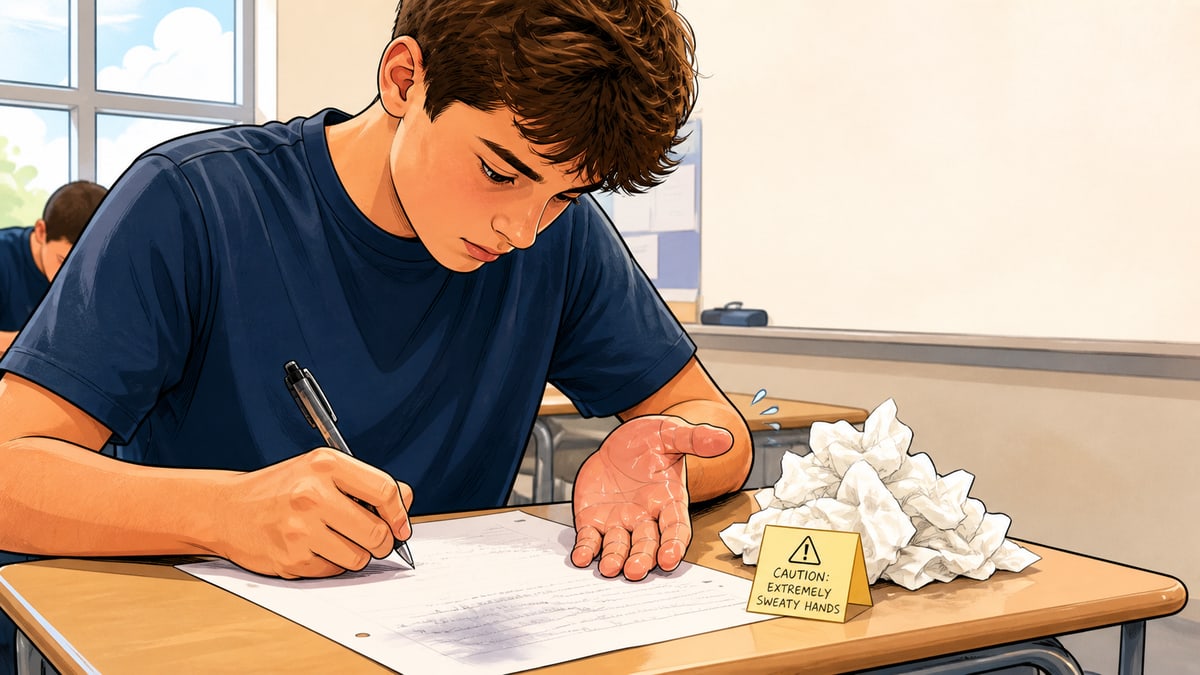
When Sweaty Hands Make School Harder
If your hands sweat a lot while writing or taking tests, I want you to know something right away: this is not laziness, nervousness, poor planning, or “just being dramatic.” I have dealt with this problem before, and I know how frustrating it can be to sit down with a pencil, a worksheet, or an exam booklet and already feel like you are fighting your own hands before you even start.
Sweaty hands can make simple school tasks feel harder than they look from the outside. A pen slips. Pencil marks smear. Paper wrinkles. The side of your hand drags moisture across the page. You keep wiping your palm on your pants, your sleeve, a tissue, or the edge of the desk, hoping no one notices. Meanwhile, everyone else seems to be writing normally, which can make the whole thing feel even more isolating.
For some people, sweaty hands are part of a medical condition called hyperhidrosis. Hyperhidrosis means the body produces more sweat than it needs for cooling, and it can affect areas such as the palms, soles, underarms, face, or scalp.1 When it affects the hands, it can interfere with writing, using a computer, holding paper, or handling everyday objects.2
Why This Happens
Everyone sweats, but hyperhidrosis is different from normal sweating. With hyperhidrosis, sweating may happen even when the room is cool, when the body does not need cooling, or when the situation does not seem stressful to anyone else.1 Primary focal hyperhidrosis often begins in childhood or adolescence and commonly affects the palms, underarms, feet, scalp, or face.3
That timing matters. If sweaty hands start during school years, they can show up right in the middle of the activities that require the most hand control: handwriting, note-taking, art projects, lab work, timed tests, and computer assignments.
The hard part is that sweaty hands can also get worse when you are under pressure. A test, presentation, timed essay, or classroom activity may raise stress levels, and stress can be a trigger for excessive sweating in some people.3 Then the sweating creates more stress, and the stress creates more sweating. It can become a cycle that feels unfair because it is unfair.
How Sweaty Hands Affect Writing
Writing with sweaty hands is not just uncomfortable. It can change the way your work looks, how fast you can complete it, and how confident you feel while doing it.
Common writing problems include:
- Ink smearing across the page.
- Pencil marks becoming gray, blurred, or hard to read.
- Paper becoming damp, curled, wrinkled, or torn.
- The pencil or pen slipping while you write.
- Needing to pause often to wipe your hands.
- Writing more slowly because you are trying to avoid smudges.
- Pressing too hard on the pencil or pen to keep control.
- Avoiding handwritten work even when you understand the material.
One of the most discouraging parts is that the final page may not show how much effort you put in. A teacher may see messy handwriting, smudges, or incomplete work. What they may not see is the constant stopping, wiping, adjusting, and trying again.
Children and teens with excessive hand sweating may have trouble holding a pencil or crayon, and excessive sweating can interfere with school and social activities.1 That can feel especially painful when you know your ideas are better than what your paper shows.
Why Tests Can Feel Especially Difficult
Tests can bring out the worst parts of sweaty hands because they combine pressure, time limits, silence, and limited supplies. During a regular homework assignment, you might be able to pause, switch paper, wash your hands, or take a break. During a test, you may feel trapped at your desk, trying to manage the sweating quietly while the clock keeps moving.
During tests, sweaty hands may affect:
- Speed: You may lose time wiping your hands, replacing damp paper, or rewriting smudged answers.
- Legibility: Even when you know the answer, the writing may be harder to read.
- Focus: Part of your attention goes toward managing your hands instead of thinking through the question.
- Confidence: You may worry about the paper, the teacher noticing, or the answer sheet becoming damaged.
- Multiple-choice sheets: Damp hands can make bubble sheets harder to handle cleanly.
- Essay exams: Longer writing tasks can become physically and emotionally exhausting.
This is why sweaty hands can affect performance even when you studied. It is not that you do not know the material. It is that the test environment may not be built for what your body is doing.
The Emotional Side No One Always Sees
The physical problem is only part of it. The emotional part can be just as heavy.
Sweaty hands can make you feel embarrassed before anyone else even says anything. You may worry about passing papers forward, sharing supplies, holding hands in class activities, touching a tablet screen, or handing in a damp assignment. You may start planning your whole day around avoiding moments where someone might notice.
Hyperhidrosis has been linked with quality-of-life challenges, including effects on social, emotional, school, and work experiences.4 Students with excessive sweating have reported that it negatively affects many areas of life, including physical, social, emotional, and functional areas.5
If you have ever felt alone with this, I understand. It can be upsetting to struggle with something that other people think is small. But when it touches your schoolwork, your grades, your comfort, and your confidence, it is not small.
Practical Ways to Make Writing Easier
There is no single trick that works for everyone, but small changes can reduce the daily struggle. The goal is not perfection. The goal is to make writing less stressful and give yourself a better chance to show what you know.
Helpful supplies to try
| Problem | Possible Help | Why It May Help |
|---|---|---|
| Ink smears easily | Try quick-drying pens, ballpoint pens, or pencils | Some inks dry faster and are less likely to drag across the page. |
| Paper gets damp | Keep a clean sheet of paper under your writing hand | The extra sheet can absorb moisture and protect the page underneath. |
| Pen or pencil slips | Use a textured grip or larger barrel pen | A better grip can reduce slipping and hand tension. |
| Hands need frequent wiping | Keep a small towel, tissue, or absorbent cloth nearby | Having it ready can reduce interruptions and embarrassment. |
| Long assignments become difficult | Break writing into shorter sections when possible | Short pauses can help you reset your hands and your focus. |
| Touchscreens do not respond well | Use a stylus, external keyboard, or paper towel under the palm | This can reduce slipping and accidental marks on screens. |
More writing tips
- Use a clipboard or firm writing surface so damp paper does not soften against the desk.
- Try thicker paper when you have control over the paper type.
- Keep extra pencils or pens so you can switch when one becomes slippery.
- Place a folded tissue or small cloth under your palm while writing.
- Use pencil when ink smearing is a major problem, unless the assignment requires pen.
- For left-handed writers, experiment with hand position and quick-drying ink to reduce dragging across fresh writing.
- When allowed, type assignments instead of handwriting them.
Some of these tips may feel small, but small changes matter when you are dealing with this every day.
Test Day Strategies
Test days need a plan that is simple enough to follow under pressure. You should not have to invent a solution while already nervous.
Before the test
- Pack extra pens, pencils, erasers, and tissues.
- Choose the writing tool that smears the least for you.
- Bring a small clean cloth if your school allows it.
- Ask ahead of time whether you may keep tissues or blotting paper on your desk.
- Use the restroom before the test so you can wash and fully dry your hands.
- Avoid testing a brand-new pen or grip during an important exam. Use what you already trust.
During the test
- Keep a tissue or extra paper under your writing hand.
- Pause briefly between sections to dry your hands.
- For essays, outline first so you do not lose your train of thought during wiping breaks.
- For bubble sheets, fill in answers carefully and give the page a moment to dry if needed.
- If your paper becomes too damp or damaged, quietly ask for a replacement page if that is allowed.
The point is not to hide every sign of sweating. The point is to protect your work and your focus.
Asking for Support or Accommodations
Asking for help can feel awkward, especially if you are used to hiding the problem. But support can make a real difference. You do not need to give a dramatic explanation. A clear, simple explanation is enough.
You might ask a teacher, school counselor, testing coordinator, or disability services office about:
- Permission to keep a small towel, tissue, or absorbent paper at your desk.
- Extra scratch paper or replacement paper if a page becomes damp.
- Extra time for handwritten tests, especially essay exams.
- Typing instead of handwriting when appropriate.
- Using a separate answer sheet or alternative format.
- Short breaks to wash and dry hands during long exams.
- A seating arrangement that feels less exposed.
- Use of a laptop, tablet, external keyboard, or stylus if it helps more than handwriting.
A simple script you can use
“I have a medical issue that causes my hands to sweat a lot. It can make writing, handling paper, and taking timed tests harder. I am not asking to avoid the work. I am asking for small supports so I can complete the work fairly.”
That last part matters: you are not asking for an unfair advantage. You are asking for a fair chance to show what you know.
When to Talk to a Doctor
If sweaty hands are interfering with school, tests, friendships, daily tasks, or your confidence, it is reasonable to talk with a healthcare professional. A dermatologist can help determine whether the sweating is hyperhidrosis and whether it is primary hyperhidrosis or related to another medical condition or medication.6
Treatment options may include prescription antiperspirants, iontophoresis for hands or feet, botulinum toxin injections, oral medications, or other approaches depending on the person and the area affected.7 Iontophoresis uses a device that passes a mild electrical current through tap water and the skin surface, and the U.S. Food and Drug Administration has cleared this type of machine to treat hyperhidrosis of the hands and feet.7
You do not have to decide on treatment alone, and you do not have to jump straight to the most intense option. A good medical conversation should include your symptoms, your school needs, your comfort level, possible side effects, and what you have already tried.
A Final Word of Encouragement
Sweaty hands can make writing and test taking feel harder than they should be. It can affect your paper, your pace, your focus, and your confidence. But it does not mean you are careless. It does not mean you are less capable. It does not mean you are failing at something everyone else magically handles with ease.
I know how tiring it can be to think about your hands all the time. I also know that the right supplies, a little planning, supportive teachers, and medical guidance can make things feel more manageable.
You deserve to learn, write, and take tests without feeling ashamed of your hands. This problem is real, and you are not alone in it.
Sources
- American Academy of Dermatology Association. “Hyperhidrosis: FAQs.” Notes that hyperhidrosis is a treatable medical condition that causes excessive sweating, sometimes even when cool or sitting at a desk, and that children with sweaty palms may have trouble holding a pencil or crayon. https://www.aad.org/public/diseases/a-z/hyperhidrosis-overview
- Children’s Hospital of Philadelphia. “Hyperhidrosis.” Describes how excessive hand sweating can affect writing, holding papers, using touchscreens, manipulating objects, and daily activities. https://www.chop.edu/conditions-diseases/hyperhidrosis
- American Academy of Dermatology Association. “Hyperhidrosis: Signs and symptoms.” Explains common affected areas, childhood or adolescent onset, daily activity interference, and possible triggers such as anxiety, nervousness, heat, humidity, physical activity, and caffeine. https://www.aad.org/public/diseases/a-z/hyperhidrosis-symptoms
- Parashar K, Adlam T, Potts G, et al. “The Impact of Hyperhidrosis on Quality of Life: A Review of the Literature.” American Journal of Clinical Dermatology, 2023. https://pmc.ncbi.nlm.nih.gov/articles/PMC9838291/
- International Hyperhidrosis Society. “Manage Sweat at School & Work.” Summarizes school and work impacts of excessive sweating, including student quality-of-life effects. https://www.sweathelp.org/taking-action/manage-sweat-school-work.html
- American Academy of Dermatology Association. “Hyperhidrosis: Diagnosis and treatment.” Explains how dermatologists evaluate excessive sweating and consider possible causes. https://www.aad.org/public/diseases/a-z/hyperhidrosis-treatment
- American Academy of Dermatology Association. “Hyperhidrosis: Diagnosis and treatment.” Lists treatment options including antiperspirants, botulinum toxin injections, iontophoresis, oral medications, and surgical options. https://www.aad.org/public/diseases/a-z/hyperhidrosis-treatment