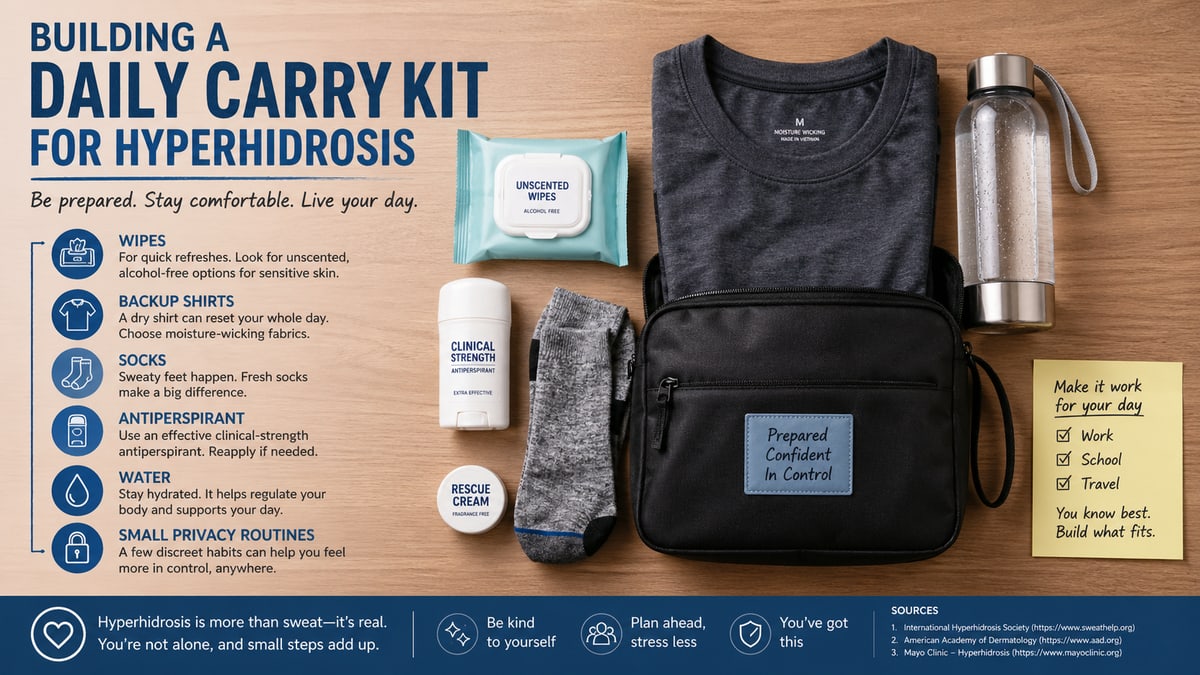
Why a carry kit helps
When you live with hyperhidrosis, leaving the house can feel like packing for a tiny emergency no one else can see. You may be thinking about your hands, underarms, face, scalp, back, feet, clothes, shoes, paperwork, phone screen, handshake, commute, classroom, meeting, date, or appointment before the day has even started.
A daily carry kit is not about being ashamed of sweating. It is about giving yourself options. A small towel, backup shirt, wipes, extra socks, or antiperspirant can be the difference between “I need to leave right now” and “I can reset and keep going.”
I think of it less like a medical kit and more like a comfort kit. Some people carry lip balm, chargers, medication, snacks, makeup, or headphones because their day goes better with those things nearby. This is the same idea. You are not being high-maintenance. You are making your day easier.
Hyperhidrosis can affect work, school, relationships, emotional well-being, clothing choices, daily routines, and quality of life.1 So having a practical plan is not overreacting. It is just being honest about what helps.
Start with your real day
The best carry kit is the one that fits your actual life. Not someone else’s perfect internet checklist. Not a giant bag full of things you will never use. Your kit should match where you sweat, how long you are usually out, what kind of privacy you have, and what would make you feel less trapped if a flare-up happens.
Before buying anything, ask yourself:
- Where do I sweat the most: hands, underarms, face, scalp, feet, back, chest, groin, or multiple areas?
- What is the moment I dread most: handshakes, sweat marks, wet socks, dripping face, odor worries, writing, phone use, public speaking, or sitting for long periods?
- How long am I usually away from home?
- Do I have access to a bathroom, locker, office drawer, car, backpack, or private space?
- Would I rather carry a tiny kit every day or keep a bigger backup kit somewhere safe?
- What item would make me feel calmer immediately?
Your answer may be simple. Maybe you only need a handkerchief and extra socks. Maybe you need a full backup shirt and underarm pads. Maybe your kit changes depending on whether it is a workday, school day, date, gym day, or travel day.
That is okay. The point is not to build the perfect kit. The point is to build one you will actually use.
The core hyperhidrosis carry kit
These are the items that help the most people, across the most situations. You do not need all of them every day. Start with the ones that would solve your most common problem.
| Item | Why it helps | Best for | Carry tip |
|---|---|---|---|
| Small towel or handkerchief | Lets you dry hands, face, neck, or scalp without relying on rough paper towels. | Hands, face, scalp, neck | Choose something thin, dark-colored, and washable. |
| Soft wipes | Helps you feel fresh after a flare-up, especially when sweat feels sticky or uncomfortable. | Underarms, hands, body, feet | Look for fragrance-free options if your skin gets irritated easily. |
| Backup shirt or undershirt | Gives you an exit ramp if visible sweat marks are making you anxious. | Underarms, chest, back, trunk | Roll it tightly and keep it in a pouch or packing cube. |
| Extra socks | Can make a huge difference if your feet get wet, cold, slippery, or odor-prone. | Feet | Keep one pair in your bag, desk, locker, or car. |
| Antiperspirant | Helps reduce sweating when used correctly, especially for underarms and sometimes hands or feet. | Underarms, hands, feet, sometimes other areas | Most antiperspirants work best on clean, dry skin, often at night rather than only during the day.2 |
| Deodorant | Helps with odor, but does not reduce sweat the way antiperspirant does. | Underarms, body odor worries | Useful as a freshening item, but do not expect it to stop sweating. |
| Plastic bag or wet bag | Separates damp socks, shirts, towels, or wipes from the rest of your things. | Any body area | A small zip bag is enough for most days. |
| Water bottle | Helps you cool down, especially during commutes, shifts, errands, and hot rooms. | Heat-triggered sweating, face/scalp sweating, general comfort | Cold water can also help cool your hands or wrists briefly. |
| Small fan | Can help you cool down before sweating escalates. | Face, scalp, upper body, full-body overheating | Best for desks, lockers, cars, dorms, or bags with extra room. |
| Paperwork/tech helpers | Protects schoolwork, forms, keyboard, phone, or tools from sweaty hands. | Hands | Try a stylus, pencil grips, thicker paper, screen protector, or keyboard cover.3 |
Build your kit by body area
Hyperhidrosis is not the same for everyone. A person with sweaty hands needs a different setup than someone with underarm sweat marks or soaked socks. Here are some practical starting points.
For sweaty hands
- Small towel, handkerchief, or microfiber cloth
- Pen or pencil grips
- Stylus for touchscreens
- Backup paper, folder, or plastic sleeve for important documents
- Hand antiperspirant if it works for you
- Thin cotton gloves for specific tasks, if appropriate
For hands, the goal is usually not “stay perfectly dry all day.” It is “make writing, typing, forms, phone use, and touch moments less stressful.”
For underarm sweating
- Clinical-strength antiperspirant
- Backup shirt or undershirt
- Underarm sweat pads or sweat-proof undershirt
- Soft wipes
- Deodorant for odor control
- Small wet bag for damp clothing
Underarm sweat can feel especially public because it shows on clothing. A backup layer gives you breathing room. Even if you rarely use it, knowing it is there can make the day feel less risky.
For face, scalp, and neck sweating
- Soft towel or handkerchief
- Cooling towel or small fan
- Water bottle
- Hair ties, clips, or headband if helpful
- Blotting papers if they feel useful for your skin
- Gentle wipes for after a flare-up
Face and scalp sweating can be hard because it is difficult to hide. A calm wipe-down routine can help you feel more in control without making it a dramatic moment.
For sweaty feet
- Extra socks
- Absorbent shoe liners
- Foot powder if your skin tolerates it
- Small bag for damp socks
- Antiperspirant spray or wipe if recommended and tolerated
- A shoe-drying routine at home
Foot sweating can affect comfort, odor, shoes, blisters, and confidence. Mayo Clinic suggests changing socks or hose one to two times a day, drying feet when changing, using moisture-wicking socks when active, and using insoles or foot powder to absorb sweat.4
For back, chest, groin, or trunk sweating
- Backup shirt or undershirt
- Moisture-wicking base layer
- Soft wipes
- Breathable underwear or backup underwear if needed
- Wet bag
- Water bottle and cooling breaks
For larger body areas, the most helpful kit item is often clothing-related. A fresh layer can change the whole rest of the day.
Product examples and useful links
These are examples, not endorsements, and not every product will work for every person. Skin sensitivity, body area, severity, cost, scent tolerance, and routine all matter. Start small when testing something new, especially with stronger antiperspirants.
| Category | Product examples | Useful for | Notes |
|---|---|---|---|
| Clinical-strength underarm antiperspirants |
Certain Dri SweatBlock Antiperspirant Wipes Carpe Underarm Stick Vanicream Anti-Perspirant/Deodorant |
Underarm sweating, sweat marks, odor anxiety | Antiperspirant reduces sweat; deodorant mainly helps odor. Stronger products can irritate skin, especially if applied after shaving, bathing, or on damp skin. |
| Hand and foot antiperspirant products |
Carpe Hand, Foot & Underarm SweatBlock Max Clinical Body Wipes |
Hands, feet, body areas where standard underarm sticks are awkward | Patch test first. Avoid broken or irritated skin. Be careful around eyes and mucous membranes. |
| Prescription topical wipes |
Qbrexza information from IHHS Qbrexza prescribing information |
Primary underarm hyperhidrosis when prescribed | This is medication, not a casual freshening wipe. Use only as prescribed. Wash hands after use and avoid touching your eyes after application.5 |
| Sweat-proof undershirts |
Thompson Tee Ejis Sweat Proof Undershirts Numi Sweat-Proof Undershirts |
Underarm sweat marks, work clothes, dress clothes, school uniforms | Best when visible underarm marks are your main concern. Some are warmer than normal undershirts, so test before a high-stakes day. |
| Underarm sweat pads |
PURAX Underarm Pads Sirona Underarm Sweat Pads |
Occasional protection, events, uniforms, travel | These can be helpful but may shift, show, or feel bulky depending on your clothing and sweat level. |
| Moisture-wicking socks |
Darn Tough Merino Athletic Socks Smartwool moisture-wicking socks at REI |
Foot sweating, long shifts, school days, commutes, travel | Wool or synthetic moisture-wicking socks usually perform better than basic cotton when feet sweat heavily. |
| Shoe-drying support | PEET Dryer | Wet shoes, odor worries, plantar hyperhidrosis | Useful as a home routine rather than something you carry. Dry shoes fully between wears whenever possible. |
Pocket kit, bag kit, and locker/car kit
You do not have to carry everything everywhere. It usually works better to think in layers.
The pocket kit
Best for quick errands, short dates, meetings, or times when you do not want to carry a bag.
- One small handkerchief or cloth
- A few tissues or soft wipes
- Small antiperspirant or deodorant if useful
- One folded plastic bag for damp items
The daily bag kit
Best for school, work, commuting, long errands, appointments, or being out for several hours.
- Small towel or handkerchief
- Soft wipes
- Backup shirt or undershirt
- Extra socks
- Antiperspirant or prescribed product
- Wet bag or zip bag
- Water bottle
- Stylus, pencil grip, or paper protector if hands are an issue
The locker, desk, or car kit
Best for backup security. This is the kit you hope you do not need, but you are very glad exists when a flare-up hits hard.
- Full change of shirt or uniform
- Extra socks and underwear if needed
- Larger towel
- Extra antiperspirant or deodorant
- Extra wipes
- Spare shoes or shoe liners if foot sweating is severe
- Plastic bag for damp clothes
- Small fan if you have a desk, locker, or private space
If you tend to overpack because anxiety tells you to prepare for everything, try this rule: carry what you use weekly, store what you use monthly, and leave the rest at home.
Small privacy routines
A good carry kit is only half the plan. The other half is knowing how to use it without feeling like you are making a scene.
The bathroom reset
- Go to the restroom before the high-pressure part of the day.
- Dry hands, face, underarms, or feet as needed.
- Change socks or shirt if needed.
- Put damp items in a plastic bag.
- Take one slow breath before going back out.
The car reset
- Keep a backup shirt, towel, socks, and wipes in a small pouch.
- Arrive a few minutes early if you can.
- Use the car as a private cool-down space before walking in.
- Do not sit there punishing yourself. Reset and move on.
The desk or locker reset
- Keep supplies in a neutral pouch so you do not feel exposed.
- Use breaks to swap socks, dry hands, or change undershirts.
- Keep a small towel where you can reach it without digging.
- If you use a fan, keep it aimed comfortably rather than blasting yourself only after you are already overwhelmed.
The “before I leave” routine
- Apply treatment products at the right time, especially if they work best at night.
- Pack one fresh cloth or towel.
- Check that your backup item is still clean.
- Refill water.
- Restock wipes or socks if you used them yesterday.
A routine helps because it removes decisions. When sweating already takes up enough brain space, fewer decisions is a gift.
Antiperspirant tips that actually matter
A lot of people give up on antiperspirants because they sting, irritate, stain clothing, or seem not to work. Sometimes the product really is not a good fit. But sometimes the timing and application are the problem.
Dermatology sources commonly recommend applying antiperspirant to completely dry skin, often before bed, because nighttime application gives the product a better chance to work while sweating is lower. Applying to wet skin, freshly shaved skin, irritated skin, or broken skin can increase stinging and irritation.2
Basic antiperspirant routine
- Apply to clean, fully dry skin.
- Use at night if the product directions recommend it.
- Let it dry before putting on clothing.
- Use sparingly at first, especially with strong formulas.
- Do not apply to broken, irritated, or freshly shaved skin.
- If irritation happens, stop and reassess instead of forcing it.
Antiperspirant vs. deodorant
Antiperspirants reduce sweat. Deodorants help with odor. Many products combine both, but they are not the same thing. If your main issue is wetness, make sure the product actually says “antiperspirant,” not just “deodorant.”
Prescription wipes
If you carry a prescription wipe like Qbrexza, treat it like medication. It is not the same as a body wipe. Use it exactly as prescribed, wash your hands after applying, and be careful not to touch your eyes. Side effects can include dry mouth, blurred vision, urinary symptoms, dry eyes, constipation, and overheating risk in hot environments.5
Work, school, errands, and appointments
Your kit may need to change depending on where you are going. The same setup that works for a grocery run may not be enough for a full shift, exam day, or medical appointment.
| Situation | Most useful kit items | Small routine that helps |
|---|---|---|
| Commute | Water, towel, wipes, backup shirt, fan if possible | Arrive early enough to cool down before going inside. |
| Work shift | Extra shirt/uniform, towel, wipes, socks, deodorant, antiperspirant | Use breaks as reset points instead of waiting until you feel desperate. |
| School day | Towel, pencil grips, thick paper, stylus, extra socks, backup shirt | Keep supplies in a small pouch so you can use them without explaining everything. |
| Errands | Small towel, wipes, water, pocket antiperspirant or deodorant | Choose cooler times of day and group stops so you are not repeatedly overheating. |
| Appointment | Towel, water, personal pen, wipes, backup layer | Arrive early and take a bathroom reset before check-in if needed. |
| Date or social outing | Small cloth, wipes, backup layer, breath mints, water | Keep the kit discreet and focus on comfort, not perfection. |
| Travel | Multiple socks, shirts, wipes, wet bag, antiperspirant, shoe plan | Pack by day and keep one emergency set accessible, not buried in luggage. |
When small accommodations help
Sometimes a carry kit is enough. Sometimes you also need a small adjustment from your school or workplace.
Useful accommodations might include:
- permission to keep water, a towel, or a fan nearby
- extra uniform shirts or permission to change during a shift
- a cooler workspace or seat away from heat sources
- typed assignments instead of handwritten ones
- extra time for tests if sweaty hands slow writing
- keyboard covers, stylus use, or protective paper sleeves
- short reset breaks when symptoms flare
In the United States, the EEOC explains that a reasonable accommodation can be a change in the work environment or in the way a job is usually done, and that a person can request an adjustment in plain English without using legal phrases like “reasonable accommodation” or “ADA.”6
You do not have to overshare. You can keep the focus on the practical barrier and the practical fix.
“I have a medical condition that causes excessive sweating, and it affects my hands during certain tasks. Keeping a small towel and using a keyboard cover would help me work more comfortably.”
What to say if someone notices
You do not owe everyone an explanation. But having a simple sentence ready can keep you from freezing if someone comments or if you need to step away.
If someone notices your sweating
“I have hyperhidrosis, so I sweat more than most people. I’m okay, it’s just something I manage.”
If you need a minute
“I need a quick minute to cool down. I’ll be right back.”
If your hands are wet
“My hands sweat because of a medical condition. Let me dry them quickly.”
If you do not want to discuss it
“It’s a medical thing I deal with. I’m okay, but I’d rather not get into it right now.”
If you are asking for support
“I do better when I can keep a small towel and backup shirt nearby. It helps me stay focused instead of worrying about sweat all day.”
The best explanation is usually short, calm, and not self-insulting. You do not have to call yourself gross. You do not have to apologize for having symptoms. You can just name the situation and move on.
Sample kits for different days
Minimal everyday kit
- Handkerchief or small towel
- Soft wipes
- Small plastic bag
- Water bottle
Work or school kit
- Small towel
- Wipes
- Backup shirt or undershirt
- Extra socks
- Antiperspirant or deodorant
- Stylus, pencil grip, or keyboard cover if hands are a problem
- Wet bag
Underarm-focused kit
- Clinical-strength antiperspirant
- Deodorant
- Underarm pads or sweat-proof undershirt
- Backup shirt
- Soft wipes
Hand-focused kit
- Handkerchief or microfiber cloth
- Stylus
- Pen or pencil grips
- Folder or plastic sleeve for paperwork
- Hand antiperspirant if tolerated
Foot-focused kit
- Extra socks
- Absorbent shoe liners
- Small bag for damp socks
- Foot powder if tolerated
- Backup shoes if you have access to a car, locker, or office
Long-day or travel kit
- Two small towels
- Wipes
- Two backup shirts or undershirts
- Two pairs of socks
- Wet bag
- Antiperspirant/deodorant
- Water bottle
- Portable fan
- Any prescribed product you use
When a kit is not enough
A carry kit can make life easier, but it should not have to carry the whole burden. If you are building your entire day around sweating, avoiding normal activities, missing school or work, changing clothes constantly, or feeling trapped by fear of flare-ups, it may be time to revisit treatment options with a clinician.
That does not mean your kit failed. It means your symptoms deserve more support.
Hyperhidrosis treatment can include topical antiperspirants, prescription wipes, iontophoresis, oral medications, botulinum toxin injections, energy-based procedures, and other options depending on the body area and severity. A practical kit helps you get through the day, but treatment may help make the day less difficult in the first place.
It can also help to talk with a counselor or therapist if sweating has created panic, avoidance, shame, or constant fear of being noticed. That does not mean the sweating is “all in your head.” It means the emotional load deserves care too.
Final thought
A daily carry kit is not about hiding who you are. It is about giving yourself a little more peace when your body does something stressful.
You do not need to pack for every possible disaster. You just need a few tools that help you reset: something to dry off, something to freshen up, something to change into, something to protect your clothes or shoes, and a small routine that lets you step away without spiraling.
Start small. Keep what works. Remove what you never use. Let the kit fit your actual life.
The goal is not to never sweat. The goal is to feel less controlled by the possibility of sweating.
Footnotes
- Parashar K, Adlam T, Potts G. “The Impact of Hyperhidrosis on Quality of Life: A Review of the Literature.” American Journal of Clinical Dermatology. 2023;24(2):187-198. DOI: 10.1007/s40257-022-00743-7. Available at: https://pmc.ncbi.nlm.nih.gov/articles/PMC9838291/. Also see Kamudoni P, Mueller B, Halford J, et al. “The impact of hyperhidrosis on patients’ daily life and quality of life: a qualitative investigation.” Health and Quality of Life Outcomes. 2017;15:121. DOI: 10.1186/s12955-017-0693-x. Available at: https://pmc.ncbi.nlm.nih.gov/articles/PMC5465471/. Back
- American Academy of Dermatology. “Hyperhidrosis: Diagnosis and treatment.” Available at: https://www.aad.org/diseases/a-z/hyperhidrosis-treatment. Also see American Academy of Dermatology. “Hyperhidrosis: 6 tips dermatologists give their patients.” Available at: https://www.aad.org/public/diseases/a-z/hyperhidrosis-self-care. Mayo Clinic. “Hyperhidrosis: Diagnosis and treatment.” Available at: https://www.mayoclinic.org/diseases-conditions/hyperhidrosis/diagnosis-treatment/drc-20367173. International Hyperhidrosis Society. “Tips for Best Results: OTC Antiperspirants.” Available at: https://www.sweathelp.org/component/content/article.html?id=153. Back
- International Hyperhidrosis Society. “Manage Sweat at School & Work.” This resource includes practical suggestions for school and work, including writing tools, technology protection, absorbent supplies, clothing, and footwear strategies. Available at: https://www.sweathelp.org/taking-action/manage-sweat-school-work.html. Back
- Mayo Clinic. “Hyperhidrosis: Diagnosis and treatment.” Lifestyle guidance includes changing socks or hose, drying feet, using moisture-wicking socks when active, using insoles or foot powder, and allowing feet/shoes to dry when possible. Available at: https://www.mayoclinic.org/diseases-conditions/hyperhidrosis/diagnosis-treatment/drc-20367173. Back
- Qbrexza prescribing information. Drugs.com professional monograph, updated Dec. 12, 2025. Available at: https://www.drugs.com/pro/qbrexza.html. Also see International Hyperhidrosis Society. “Qbrexza Rx Topical Cloths/Wipes.” Available at: https://www.sweathelp.org/treatments-hcp/qbrexza.html. Back
- U.S. Equal Employment Opportunity Commission. “Small Employers and Reasonable Accommodation.” The EEOC explains that a person may request an accommodation in plain English and does not need to use specific legal phrases. Available at: https://www.eeoc.gov/laws/guidance/small-employers-and-reasonable-accommodation. Back
- Product pages used for examples: Certain Dri, SweatBlock Antiperspirant Wipes, Carpe Underarm Stick, Vanicream Anti-Perspirant/Deodorant, Thompson Tee, Ejis, Numi, PURAX Underarm Pads, Darn Tough Merino Socks, and PEET Dryer. Product availability, claims, and pricing can change. Back