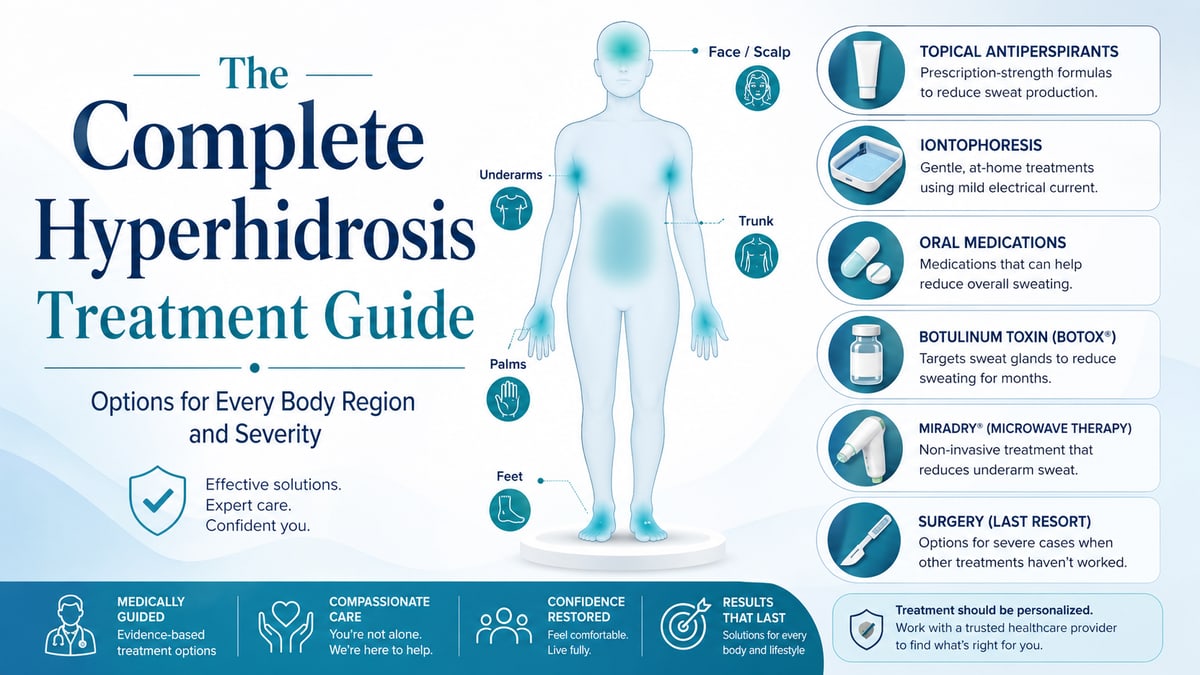
Hyperhidrosis Treatment Options
A comprehensive guide for patients, clinicians, and hyperhidrosis communities
Medical note: This guide is educational. It is not a diagnosis, prescription, or substitute for a clinician who can examine the sweating pattern, review medications, and screen for secondary causes.
Executive summary
Hyperhidrosis treatment works best when it is matched to three things: the pattern of sweating, the affected body region, and severity. Primary focal hyperhidrosis usually affects specific sites such as the underarms, palms, soles, face, or scalp. Secondary or generalized sweating can be caused by medications, endocrine disease, infection, neurologic disease, malignancy, menopause, substance use, or other systemic problems, so it deserves evaluation before people simply start stacking sweat blockers on top of the problem.1, 2, 3, 4
The best-supported first-line treatment for many mild focal cases is an aluminum-salt antiperspirant, usually applied at night to completely dry skin. Underarm disease has the broadest menu: prescription topical anticholinergics such as glycopyrronium cloth and sofpironium gel, botulinum toxin injections, the Brella patch, microwave thermolysis with miraDry, and local sweat-gland surgery. Palmar and plantar disease often should move to iontophoresis early rather than wasting months on irritating topical experiments. Craniofacial disease has a useful niche for topical glycopyrrolate. Multifocal, truncal, groin, or generalized symptoms often push treatment toward oral anticholinergics, assuming secondary causes have been considered.1, 2, 5, 6, 7
For severe focal disease, botulinum toxin is one of the strongest non-surgical options. OnabotulinumtoxinA has the clearest evidence and U.S. labeling for severe primary axillary hyperhidrosis inadequately controlled by topical agents. Palmar, plantar, craniofacial, groin, inframammary, and truncal use is usually off-label but common in specialist practice. The trade-off is predictable: cost, pain, repeat sessions, and site-specific weakness risks, especially transient hand weakness after palmar injections.17, 18, 19, 20
Endoscopic thoracic sympathectomy, often called ETS or sympathotomy, is the most definitive option for carefully selected, severely impaired palmar cases after conservative treatment failure. It is also the treatment most likely to produce regret if presented casually. Compensatory sweating is common and can be more disruptive than the original sweating. Any patient community discussing ETS should make that trade-off clear and prominent.26
Start with the sweating pattern
Primary focal hyperhidrosis
Primary focal hyperhidrosis is typically bilateral, focal, excessive, and not explained by another condition. It often starts in childhood, adolescence, or early adulthood and affects the axillae, palms, soles, face, or scalp. Common diagnostic features include visible excessive sweating for at least 6 months without an apparent cause plus supporting features such as bilateral symmetry, impairment of daily activities, at least weekly episodes, onset before age 25, family history, and absence of sweating during sleep.1, 2, 3
Secondary or generalized hyperhidrosis
Secondary hyperhidrosis is sweating caused by another condition or exposure. Clues include new onset later in life, generalized sweating, night sweats, fever, weight loss, asymmetric sweating, medication changes, substance use, endocrine symptoms, neurologic symptoms, or sweating that begins after a known illness. Antidepressants, opioids, thyroid disease, diabetes, infections, menopause, malignancy, and autonomic disorders are among the many possibilities. The workup should be guided by history and exam rather than a giant random lab panel, because medicine should occasionally pretend to be efficient.3, 4, 27
Why the distinction matters
Treating secondary sweating as if it were ordinary primary focal hyperhidrosis can delay diagnosis of the actual problem. It can also push people toward ineffective focal treatments. For example, miraDry may help axillary sweating, but it will not fix medication-induced whole-body sweating. Qbrexza or Sofdra may help underarms, but they are not generalized-sweating drugs. ETS may dry palms, but it is not a rational response to unexplained night sweats.
Severity and body-region framework
The Hyperhidrosis Disease Severity Scale, or HDSS, is a simple patient-reported severity tool. A score of 1 means sweating is not noticeable and does not interfere with daily activities. A score of 2 means sweating is tolerable but sometimes interferes. A score of 3 means sweating is barely tolerable and frequently interferes. A score of 4 means sweating is intolerable and always interferes. A 1-point HDSS improvement is commonly interpreted as clinically meaningful, and larger improvements often correspond with major reductions in measured sweat production.5
| Severity | Typical HDSS | Practical meaning | Typical treatment posture |
|---|---|---|---|
| Mild | 1 to 2 | Noticeable or inconvenient, but not dominating daily life. | Education, trigger management, antiperspirants, targeted topical treatment. |
| Moderate | 2 to 3 | Frequent interference with work, school, clothing, social contact, grip, footwear, or grooming. | Prescription topicals, iontophoresis for palms/soles, oral adjuncts if multifocal, botulinum toxin if focal and disabling. |
| Severe | 3 to 4 | Major quality-of-life impairment, avoidance behavior, occupational limitation, or repeated treatment failure. | Botulinum toxin, combination therapy, durable axillary procedures, systemic treatment, specialist referral, and for severe refractory palmar disease, possible ETS counseling. |
Region matters as much as severity. Underarms have the most approved and device-based options. Hands and feet have the strongest case for iontophoresis. The face and scalp require more careful topical and injection technique. Trunk, groin, and inframammary sweating are under-studied, so treatment often relies on systemic therapy, careful off-label local treatment, and skin-friction management.1, 2, 6, 29
Treatment ladder by region
| Body region | Mild to moderate disease | Moderate to severe disease | Refractory disease |
|---|---|---|---|
| Axillary | Aluminum-salt antiperspirant, clothing strategies, prescription topical anticholinergic if needed. | Qbrexza, Sofdra, botulinum toxin, oral adjunct if multifocal, Brella if office patch treatment fits. | miraDry, local axillary sweat-gland surgery, selected specialist off-label approaches. ETS is not a casual underarm shortcut. |
| Palmar | Antiperspirant if tolerated, early iontophoresis. | Iontophoresis optimization, botulinum toxin, oral anticholinergic if multifocal or event-heavy. | ETS or sympathotomy only after conservative failure and serious compensatory-sweating counseling. |
| Plantar | Footwear rotation, moisture-wicking socks, antiperspirant, iontophoresis. | Botulinum toxin, oral adjuncts, combination management for maceration and odor. | Specialist off-label care. Permanent local procedures are less established than for axillae. |
| Craniofacial | Topical glycopyrrolate or careful topical antiperspirant use away from eyes. | Botulinum toxin in experienced hands, oral anticholinergic if broader pattern. | Highly selective surgical discussion only in true refractory primary cases. |
| Trunk, groin, inframammary | Anti-chafe measures, absorbent products, breathable clothing, cautious topical therapy. | Oral anticholinergic, selected off-label botulinum toxin, treatment of intertrigo or skin breakdown. | Specialist care. Evidence for devices and surgery is limited. |
| Generalized or secondary-predominant | Medication review, diagnosis of underlying cause, trigger management. | Treat cause; add systemic symptom control only when appropriate. | Site-specific focal procedures only for persistent focal problems after systemic assessment. |
Treatment options in detail
1. Supportive measures and trigger management
Mechanism: Supportive measures do not shut down sweat glands. They reduce visible wetness, odor, friction, skin breakdown, shoe damage, and social consequences.
Best fit: All body regions and all severities, especially as background care for plantar, truncal, groin, and generalized disease.
Examples: Sweat journaling, medication and trigger review, breathable fabrics, dark or patterned clothing, undershirts, underarm shields, absorbent pads, spare clothing, moisture-wicking socks, shoe rotation, absorbent insoles, antifungal or anti-chafe management when needed, and planning around heat exposure or high-stakes events.6, 7
Pros: Low cost, low risk, immediately available, useful even when medical treatment works only partially.
Cons: Often inadequate for moderate or severe disease. It treats consequences more than sweat output.
Tip: Community advice should not reduce severe hyperhidrosis to "wear better shirts." That is symptom management, not adequate treatment for severe disease.
2. Aluminum-salt antiperspirants
Mechanism: Aluminum chloride and related salts form plugs in sweat ducts and reduce sweat reaching the skin surface. They are antiperspirants, not ordinary deodorants. Deodorants mainly target odor.
Best fit: First-line for many mild to moderate focal cases, especially axillary hyperhidrosis. They can be tried on palms and soles but are often less effective or more irritating there.1, 2, 3
How to use: Apply at night to completely dry skin. Wash off in the morning if directed. Avoid broken skin, freshly shaved skin, and immediate post-shower dampness. Use nightly until control improves, then reduce to maintenance several times weekly or less.
Efficacy: Good first-line evidence and long clinical experience, particularly for underarms. For palmar or plantar disease, real-world success is more variable and technique-dependent.
Side effects: Burning, itching, irritant dermatitis, fabric staining, and poor adherence when irritation is bad.
Contraindications/cautions: Avoid damaged skin and sensitive areas near eyes or mucosa.
Cost: Usually low. OTC and prescription options are widely available.
Pros: Cheap, accessible, no systemic anticholinergic effects, easy to combine with other treatments.
Cons: Irritation is common, efficacy may be insufficient for severe disease, and hands/feet can be difficult.
3. Topical anticholinergics
Topical anticholinergics block acetylcholine signaling to eccrine sweat glands. The appeal is obvious: local treatment without the full systemic burden of oral anticholinergics. The catch is that systemic side effects can still happen, especially with overuse, large treated areas, broken skin, or accidental eye transfer.
Qbrexza: glycopyrronium cloth 2.4%
Best fit: Primary axillary hyperhidrosis in adults and pediatric patients age 9 and older. In the U.S., Qbrexza is labeled for underarms, not palms, soles, face, groin, or generalized sweating.8
Use: One cloth is used once daily for both underarms. Hands should be washed immediately after application, and patients should avoid touching the eyes.
Efficacy: In pivotal trials, glycopyrronium cloth produced statistically significant improvements in sweating severity and sweat production compared with vehicle. Trial publications and FDA materials support clinically meaningful underarm symptom reduction over the first several weeks.8, 9
Side effects: Dry mouth, dilated pupils, blurred vision, headache, urinary hesitation or retention, local burning, itching, redness, and heat intolerance risk.
Contraindications/cautions: Conditions worsened by anticholinergic effects, including glaucoma, paralytic ileus, severe ulcerative colitis or toxic megacolon, myasthenia gravis, Sjogren syndrome, and unstable cardiovascular status in acute hemorrhage. Urinary retention risk matters.8
Cost/access: Prescription brand medication. Coverage, prior authorization, and manufacturer programs can dominate actual cost.
Pros: Needle-free, at-home, evidence-based for axillary disease, can be combined with antiperspirant strategy if tolerated.
Cons: Ongoing daily use, anticholinergic side effects, axillary-only labeling, insurance friction.
Tip: Eye transfer is a classic avoidable problem. Blurred vision after application often suggests accidental transfer to the eyes and should prompt immediate review of technique and safety guidance.
Sofdra: sofpironium topical gel 12.45%
Best fit: Primary axillary hyperhidrosis in adults and pediatric patients age 9 and older. Sofdra is another prescription topical anticholinergic for underarms.10
Use: Apply one pump to each underarm once daily at bedtime to clean, dry, intact skin. Wash hands immediately. Avoid shaving shortly before application and avoid showering soon after application according to product instructions.
Efficacy: Phase 3 studies support improvement in axillary symptom scores, and FDA materials support its approved indication. It is newer than Qbrexza, so long-term real-world experience is still developing.10, 11
Side effects: Dry mouth, blurred vision, dilated pupils, application-site pain, redness, dermatitis, itching, irritation, urinary retention, and reduced sweating with heat illness risk.
Contraindications/cautions: Same anticholinergic logic as Qbrexza: glaucoma and other conditions worsened by anticholinergic effects, urinary retention risk, heat exposure risk, and ocular transfer risk.10
Cost/access: Prescription brand medication. Cash price can be high; insurance and savings programs are often decisive.
Pros: At-home, once-daily, FDA-approved for axillary disease.
Cons: Not a permanent treatment, underarm-only labeling, anticholinergic side effects, pricing uncertainty.
Compounded topical glycopyrrolate for face/scalp
Best fit: Craniofacial hyperhidrosis, including forehead, scalp margin, upper lip, and selected facial areas. It may also be used off-label at other focal sites by experienced clinicians, but facial use has the clearest practical niche.29
Use: Usually compounded as a solution, cream, pad, or wipe. Application must be careful and conservative, especially near the eyes.
Efficacy: Small studies and expert guidance support meaningful reduction in craniofacial sweating. Botulinum toxin may outperform topical glycopyrrolate in selected facial cases, but topical therapy is less invasive and easier to trial first.29
Side effects: Irritation, dry mouth, blurred vision, and accidental eye exposure. Systemic anticholinergic effects are possible.
Pros: Useful for a site where antiperspirants are awkward and injections require technique.
Cons: Compounding variability, limited large-trial data, eye-transfer risk.
Emerging and off-label topical options
Topical oxybutynin, topical umeclidinium, and topical botulinum toxin concepts have appeared in studies or reviews. Some signals are promising, especially topical oxybutynin for palmar disease, but these options are not yet as established as aluminum salts, Qbrexza, Sofdra, iontophoresis, oral anticholinergics, botulinum toxin injections, or axillary devices.31
Tip: Experimental does not mean fake. It also does not mean proven. Patients should understand the difference between promising early data and established standard care.
4. Iontophoresis
Mechanism: Iontophoresis passes a mild electrical current through water and skin. The exact mechanism is not fully settled, but the treatment can reduce sweat output, likely through functional interference with sweat gland activity and ductal transport.
Best fit: Palmar and plantar hyperhidrosis. It can also be used for axillae with special pads, but hands and feet are the classic high-value use case.1, 12
Use: Hands or feet are placed in shallow trays of water connected to a device. Typical induction is 15 to 30 minutes per session, several times weekly, until dryness improves. Maintenance is usually weekly, every other week, or individualized. Some patients add baking soda/mineral water or use anticholinergic-enhanced iontophoresis under medical guidance.
Efficacy: In a randomized sham-controlled trial of palmar hyperhidrosis, active tap-water iontophoresis produced clinical improvement in 92.9% of treated patients after 10 treatments compared with 38.5% in the sham group.12 Other studies support tap-water iontophoresis and glycopyrrolate-enhanced approaches, although protocols vary.13
Side effects: Tingling, stinging, redness, dryness, fissures, vesicles, and occasional small burns if settings or technique are poor.
Contraindications/cautions: Common exclusions include pacemakers or implanted electrical devices, pregnancy, significant cardiac disease, epilepsy, metal implants in the current path, and broken or inflamed treatment skin. Device instructions vary.
Cost/access: Home devices commonly cost several hundred dollars to around $1,000 depending on brand, configuration, and market. Some insurers reimburse with documentation.
Pros: Strong palmar/plantar utility, non-systemic, home-manageable, good long-term value once a device is owned.
Cons: Time burden, maintenance dependence, technique issues, device cost up front.
Tip: Iontophoresis often fails because people stop during the boring induction phase. Sweat glands apparently do not respect impatient consumer behavior.
5. Oral medications
Oral medications are most useful when sweating is multifocal, generalized after evaluation, truncal, groin/inframammary, or not practical to treat region by region. The main class is anticholinergics. They can work very well, but the side effects are not incidental. They are the treatment.
Oral glycopyrrolate
Mechanism: Systemic muscarinic blockade reduces eccrine gland stimulation.
Best fit: Multifocal sweating, generalized symptom control after secondary causes are addressed, craniofacial/truncal/groin patterns, and adjunct use when focal treatments leave residual sweating.
Efficacy: Observational and retrospective literature supports meaningful improvement in many patients, including pediatric series where glycopyrrolate was used after aluminum-salt failure or intolerance.14
Side effects: Dry mouth, constipation, blurred vision, urinary hesitancy, tachycardia, drowsiness, overheating risk, and reduced exercise/heat tolerance.
Contraindications/cautions: Glaucoma, urinary retention, bowel obstruction or severe motility disorders, myasthenia gravis, severe ulcerative colitis/toxic megacolon risk, and caution with heat exposure or endurance exercise.
Cost/access: Generic glycopyrrolate is often relatively inexpensive, though dose and pharmacy pricing vary.
Pros: Treats multiple regions at once, inexpensive as a generic, useful for hard-to-target body areas.
Cons: Side effects often cap the usable dose. Benefit stops when the medication stops.
Oral oxybutynin
Mechanism: Systemic anticholinergic effect, originally used mainly for bladder indications but widely used off-label for hyperhidrosis.
Best fit: Palmar, plantar, axillary, truncal, craniofacial, and multifocal disease when local therapies are inadequate or impractical.
Efficacy: Reviews and prospective series support moderate to major improvement in many patients with focal and multifocal hyperhidrosis. Long-term series suggest sustained benefit in responders, though discontinuation due to dry mouth and other side effects is common enough to matter.15, 16
Side effects: Dry mouth, constipation, drowsiness, blurred vision, urinary retention, cognitive fog in susceptible patients, and heat intolerance.
Cost/access: Usually low-cost generic, making it one of the more accessible systemic treatments.
Pros: Broad reach, low cost, useful for body sites with weak local evidence.
Cons: Anticholinergic burden, heat/exercise caution, no durability after stopping.
Tip: An effective dose that the patient cannot tolerate is not a success. It should prompt dose adjustment, switching therapy, or discontinuation under medical guidance.
Situational beta blockers and anxiolytics
Mechanism: These do not directly treat eccrine gland overactivity. They reduce sympathetic or anxiety-driven amplification around predictable events such as presentations, interviews, performances, dates, or exams.
Best fit: People whose sweating spikes during specific high-stress events, especially when baseline sweating is otherwise manageable.
Examples: Low-dose propranolol before an event is commonly discussed in clinical guidance. Short-term benzodiazepines may be considered in carefully selected cases, but sedation and dependence risks matter.6
Contraindications/cautions: Beta blockers can be inappropriate in bradycardia, some asthma/COPD patterns, certain conduction disorders, and hypotension. Benzodiazepines can impair driving, cognition, and coordination and carry dependency risk.
Pros: Targeted, occasional use, can help event-triggered spirals.
Cons: Poor fit for all-day biological hyperhidrosis; does not treat sweat glands directly.
6. Botulinum toxin injections
Mechanism: Botulinum toxin blocks acetylcholine release from cholinergic nerve endings that stimulate eccrine sweat glands. Less acetylcholine signaling means less sweat output in the injected field.
Best fit: Severe focal disease or moderate disease where local, months-long control is preferred over daily therapy. Axillary evidence is strongest. Palmar, plantar, craniofacial, scalp, groin, inframammary, and truncal injections are usually off-label but can be effective when performed by experienced clinicians.17, 18, 19, 20
Evidence: In a large randomized placebo-controlled BMJ trial of primary axillary hyperhidrosis, 50 U of botulinum toxin type A per axilla produced a responder rate of 94% at 4 weeks compared with 36% with placebo, using at least 50% reduction in sweat production as the response definition.18 A 52-week multicenter study found that both 50 U and 75 U per axilla significantly improved HDSS outcomes versus placebo, with median duration around 197 to 205 days for active treatment.19 A 2025 meta-analysis of randomized trials also supported superior sweat reduction with botulinum toxin type A for primary axillary disease.20
Procedure: The area is often mapped with a starch-iodine test, then injected intradermally in a grid. Underarm labeling for onabotulinumtoxinA uses 50 U per axilla distributed across multiple sites. Palms and soles often require anesthesia strategies because injections in these sites can be painful.
Onset/duration: Onset is usually within several days to 2 weeks. Duration varies by site and patient, commonly several months.
Side effects: Injection pain, bruising, temporary local weakness, flu-like symptoms, headache, and rare spread-of-toxin effects. Palmar injections can cause transient hand weakness. Facial injections can cause asymmetry or eyelid droop if placement is poor.
Contraindications/cautions: Infection at injection site, known hypersensitivity, and caution in neuromuscular junction disorders or when using drugs that may potentiate neuromuscular blockade.
Formulations: OnabotulinumtoxinA has the most established hyperhidrosis evidence and U.S. axillary labeling. AbobotulinumtoxinA, incobotulinumtoxinA, and rimabotulinumtoxinB have off-label literature and specialist use. Units are not interchangeable across products. Newer aesthetic toxins should not be marketed as established hyperhidrosis standards unless actual hyperhidrosis evidence exists.30
Cost/access: Often expensive without insurance. Severe primary axillary disease has the strongest path to coverage. Palmar, plantar, craniofacial, and other off-label sites may face more denial.
Pros: Strong focal efficacy, months of benefit, no daily adherence burden, highly useful when topicals fail.
Cons: Pain, cost, repeat procedures, weakness risk, variable insurance coverage.
7. Microwave thermolysis: miraDry
Mechanism: miraDry uses microwave energy to heat tissue at the dermal-subcutaneous interface in the axilla, damaging sweat glands. The goal is local, durable sweat-gland reduction.
Best fit: Primary axillary hyperhidrosis in patients who want a durable underarm procedure and are poor fits for, or tired of, repeated medication or injections. It is not for generalized sweating and is not cleared for other body regions.21
Evidence: FDA clearance and clinical studies support reduction in axillary sweating. A published clinical evaluation reported meaningful reductions in sweat production and symptom severity after microwave treatment.21, 22
Procedure: The underarms are mapped, numbed with local anesthesia, and treated with a handpiece that delivers energy while cooling the skin surface. One or two sessions are common.
Onset/duration: Improvement may be early and can be long-lasting because glands are physically damaged. Some patients need a second session.
Side effects: Swelling, soreness, tenderness, bruising, altered sensation, nodules, burns, neuropathy, and reduced underarm hair or odor. Most early discomfort is temporary, but serious complications can happen.
Cost/access: Often self-pay, commonly in the low-thousands of dollars in U.S. clinics. Insurance coverage is inconsistent.
Pros: Durable axillary-only option, avoids repeated toxin sessions for some patients, stays local rather than altering the sympathetic chain.
Cons: Cost, axillary-only use, procedure recovery, limited reversibility.
8. Brella SweatControl Patch
Mechanism: Brella is an in-office patch that uses targeted alkali thermolysis. A sodium-based sheet reacts with sweat to generate controlled local heat and reduce sweat production in the treated axillary area.
Best fit: Adults with primary axillary hyperhidrosis who want a quick, non-injectable office treatment. It is not a generalized treatment and is not a palms/soles/face treatment.23
Use: Applied by a healthcare provider to each underarm for a brief treatment period, commonly described as about 3 minutes.
Onset/duration: Public and clinical-facing materials commonly describe improvement within days and benefit lasting several months, often around 2 to 4 months.
Side effects: Local irritation, tenderness, redness, sensitivity, and transient discomfort.
Cost/access: Office-only and newer, so pricing and availability vary. Insurance patterns are still less mature than for older therapies.
Pros: Fast, needle-free, no daily home routine.
Cons: Adult axillary-only, repeat office treatments, smaller long-term evidence base than botulinum toxin or miraDry.
9. Laser and radiofrequency approaches
Mechanism: These approaches attempt local sweat-gland destruction or functional reduction through heat. Methods include Nd:YAG laser, diode laser, subdermal laser, fractional microneedle radiofrequency, and related energy devices.
Best fit: Usually axillary hyperhidrosis in specialist or cosmetic-dermatology settings.
Evidence: Mixed. Some studies report improvement, but protocols vary and not all controlled studies show convincing benefit. Current evidence is less standardized than for aluminum salts, prescription topical anticholinergics, iontophoresis, botulinum toxin, or miraDry.24
Side effects: Pain, swelling, burns, neuropathy, scarring, pigment change, and recurrence.
Pros: Local treatment with potential durability.
Cons: Technique-dependent, evidence inconsistency, private-pay risk, uncertain comparative value.
Tip: Ask clinics for actual hyperhidrosis outcome data, not generic laser enthusiasm. Device claims should be weighed against published hyperhidrosis-specific evidence.
10. Local axillary sweat-gland surgery
Mechanism: Local surgical approaches remove or destroy axillary sweat glands through curettage, liposuction, suction-curettage, excision, or combinations.
Best fit: Refractory axillary hyperhidrosis when local durability is desired and the patient accepts surgical risk. This is primarily an underarm treatment because the anatomy is more forgiving than hands, feet, face, or groin.25
Efficacy: Studies and clinical experience support potentially durable improvement, with suction-curettage often used to reduce scarring compared with wide excision. Results depend heavily on technique and operator experience.
Side effects: Scarring, infection, delayed healing, bleeding, seroma, hematoma, altered sensation, pain, contour change, and recurrence if gland removal is incomplete.
Cost/access: Variable. Coverage depends on severity documentation and payer policy.
Pros: Local, potentially durable, avoids sympathetic-chain surgery.
Cons: Surgical risk, scarring, operator-dependent outcomes, not useful for non-axillary disease.
11. Endoscopic thoracic sympathectomy or sympathotomy
Mechanism: ETS interrupts part of the thoracic sympathetic chain that drives sweating in upper-body focal patterns, especially palms.
Best fit: Severe refractory palmar hyperhidrosis after failure of conservative options, in carefully selected and carefully counseled patients. Some axillary or craniofacial cases are considered, but the risk-benefit ratio is generally less favorable than for classic palmar disease.26
Efficacy: Initial palmar dryness rates are often high in selected surgical series and consensus statements. The issue is not whether it can work. The issue is what it may cost biologically.
Side effects: Compensatory sweating, gustatory sweating, dry hands, pneumothorax, bleeding, neuralgia, recurrence, Horner syndrome risk depending on level, and regret. Compensatory sweating is the central counseling issue and can be severe.
Cost/access: High surgical-cost category. Insurers often require documentation of severe disease and failed conservative therapy.
Pros: Potentially definitive for severe palmar disease.
Cons: Irreversible or difficult to reverse, compensatory sweating can be life-altering, surgical risks, not appropriate for generalized sweating.
Tip: Patient communities should not normalize ETS as just the next step after deodorant. It is a last-line surgical option, not a routine escalation step.
Region-specific strategies
Axillary hyperhidrosis
Axillary disease has the widest treatment menu. Start with aluminum-salt antiperspirant when severity is mild or moderate. If that fails or irritates, prescription topical anticholinergics are reasonable. Botulinum toxin is the strongest non-surgical focal treatment for severe underarm disease and has robust trial data. Durable underarm options include miraDry and local gland surgery. Brella fits as a fast office option with medium duration. Laser and radiofrequency procedures are possible but should be treated as less standardized.
Palmar hyperhidrosis
Palmar disease often deserves early iontophoresis. Antiperspirants may help mild cases but can irritate and underperform. Botulinum toxin is effective but painful and can cause temporary hand weakness. Oral anticholinergics can help when hands are part of a multifocal pattern. ETS is reserved for severe refractory palmar disease after conservative failure and careful counseling.
Plantar hyperhidrosis
Plantar disease is usually a combination problem: sweat, maceration, odor, shoe damage, slipping, and sometimes fungal complications. Footwear rotation, moisture-wicking socks, antiperspirants, and iontophoresis are practical foundations. Botulinum toxin can work but is painful and logistically harder. Oral anticholinergics may be useful when feet are one of several affected sites.
Craniofacial hyperhidrosis
Craniofacial sweating requires precision. Topical glycopyrrolate is often a rational first treatment for forehead, scalp margin, and upper-lip patterns. Botulinum toxin can be effective but requires careful mapping and technique to avoid ptosis, asymmetry, or unwanted weakness. Oral anticholinergics help when the pattern is broad or combined with other sites. Gustatory sweating may respond well to botulinum toxin when focal.
Truncal, groin, and inframammary hyperhidrosis
Evidence is thinner here. Management often uses breathable clothing, absorbent products, anti-chafe care, treatment of intertrigo, oral anticholinergics, and selected off-label botulinum toxin for focal targets. Axillary devices should not be casually extrapolated to these areas. These sites should be managed according to their own anatomy, friction burden, and evidence limits.
Generalized hyperhidrosis
Generalized sweating is more likely to be secondary. The priority is history, medication review, and targeted evaluation. Treating the underlying cause is the central treatment. Oral anticholinergics may be used for symptom control when appropriate, but focal procedures should be reserved for true focal residual problems.
Cost and access considerations
Costs vary by country, insurer, clinic, pharmacy, coupon program, and whether the treatment is considered medically necessary or cosmetic. The table below is deliberately approximate. Exact prices should be checked locally before treatment decisions or insurance appeals.
| Treatment | Typical access pattern | Cost considerations |
|---|---|---|
| Supportive measures | OTC/self-directed | Low cost, recurring small purchases. |
| Aluminum-salt antiperspirants | OTC or prescription | Low cost. Irritation can lead to product cycling. |
| Qbrexza and Sofdra | Prescription brand medications | Potentially high cash price. Insurance, prior authorization, and savings programs matter. |
| Oral glycopyrrolate or oxybutynin | Prescription generics | Often relatively inexpensive compared with brand topicals or procedures. |
| Iontophoresis | Home device or clinic | Up-front device cost commonly several hundred dollars to around $1,000. Good long-term value if used consistently. |
| Botulinum toxin | Office procedure | Often expensive if self-pay. Axillary disease has the strongest insurance pathway. |
| Brella | Office procedure | Newer treatment. Pricing and availability vary; repeat sessions needed. |
| miraDry | Office procedure | Usually self-pay, often low-thousands of dollars. Second session sometimes needed. |
| Local axillary surgery | Specialist surgery | High variability; coverage depends on payer policy and documentation. |
| ETS/sympathotomy | Thoracic surgery | High surgical-cost category; requires severe disease documentation and step-therapy failure in many payer settings. |
For insurance appeals, useful documentation usually includes diagnosis, HDSS score, affected body regions, duration, failed treatments with dates, photographs or clinician documentation when appropriate, occupational or functional impairment, and quality-of-life impact. Patient communities can help people organize that documentation without inventing medical claims.
Practical guidance for a hyperhidrosis community
- Separate anecdote from evidence. A user saying iontophoresis changed their life is valuable. It is not equivalent to a randomized trial. Both can coexist without turning the forum into either a journal club or a rumor swamp.
- Ask body region first. Treatment advice that ignores location is usually bad advice. Underarms, hands, feet, scalp, groin, and generalized sweating have different ladders.
- Flag secondary-pattern red alerts. New generalized sweating, night sweats, fever, weight loss, medication-linked onset, and asymmetric sweating deserve medical evaluation.
- Normalize combination therapy. Many patients need more than one tool: iontophoresis plus antiperspirant, Botox plus oral rescue medication, or miraDry plus residual topical treatment.
- Be sober about ETS. It can be excellent for selected severe palmar cases. It can also create compensatory sweating that becomes the new problem. Both statements are true.
- Do not shame symptom-management hacks. Sweat pads, socks, undershirts, dark fabrics, and spare clothes are not cures, but they can be quality-of-life tools.
- Discourage unsafe overuse. More anticholinergic exposure is not automatically better. Heat illness, urinary retention, blurred vision, and constipation are real.
References
- International Hyperhidrosis Society. Clinical Guidelines and Treatment Algorithms for Hyperhidrosis. Available at: https://www.sweathelp.org/treatments-hcp/clinical-guidelines.html and region-specific guideline pages.
- McConaghy JR, Fosselman D. Hyperhidrosis: Management Options. American Family Physician. 2018;97(11):729-734. Available at: https://www.aafp.org/pubs/afp/issues/2018/0601/p729.html.
- Ashton S, et al. Hyperhidrosis: assessment and management in general practice. British Journal of General Practice. 2024. Available at: https://pmc.ncbi.nlm.nih.gov/articles/PMC11060811/.
- Brackenrich J, Fagg C. Hyperhidrosis. StatPearls. NCBI Bookshelf. Available at: https://www.ncbi.nlm.nih.gov/books/NBK459227/.
- International Hyperhidrosis Society. Hyperhidrosis Disease Severity Scale (HDSS). Available at: https://www.sweathelp.org/pdf/HDSS.pdf. See also Kowalski JW, et al. Validity of the Hyperhidrosis Disease Severity Scale.
- American Academy of Dermatology. Hyperhidrosis: Diagnosis and treatment. Available at: https://www.aad.org/public/diseases/a-z/hyperhidrosis-treatment.
- Mayo Clinic. Hyperhidrosis: Diagnosis and treatment. Available at: https://www.mayoclinic.org/diseases-conditions/hyperhidrosis/diagnosis-treatment/drc-20367173.
- Qbrexza (glycopyrronium) cloth, 2.4%. Prescribing information. Available at: https://www.drugs.com/pro/qbrexza.html and FDA labeling materials.
- Pariser DM, et al. Topical glycopyrronium tosylate for the treatment of primary axillary hyperhidrosis: pooled results from two phase 3 randomized controlled trials. Journal of Drugs in Dermatology. 2018. Available at: https://pmc.ncbi.nlm.nih.gov/articles/PMC6516143/.
- Sofdra (sofpironium) topical gel, 12.45%. Prescribing information. Initial U.S. approval 2024. Available at: https://www.drugs.com/pro/sofdra.html and FDA labeling materials.
- U.S. Food and Drug Administration. Drug Trials Snapshot: Sofdra. Available at: https://www.fda.gov/drugs/drug-approvals-and-databases/drug-trials-snapshots-sofdra. See also Pariser D, et al. Sofpironium topical gel for primary axillary hyperhidrosis.
- Kim DH, Kim TH, Lee SH, Lee AY. Treatment of palmar hyperhidrosis with tap water iontophoresis: a randomized, sham-controlled, single-blind, parallel-designed clinical trial. Annals of Dermatology. 2017;29(6):728-734. doi:10.5021/ad.2017.29.6.728. Available at: https://pmc.ncbi.nlm.nih.gov/articles/PMC5705354/.
- Dolianitis C, Scarff CE, Kelly J, Sinclair R. Iontophoresis with glycopyrrolate for the treatment of palmoplantar hyperhidrosis. Australasian Journal of Dermatology. 2004;45(4):208-212. PubMed: https://pubmed.ncbi.nlm.nih.gov/15527429/.
- Paller AS, Shah PR, Silverio AM, Wagner A, Chamlin SL, Mancini AJ. Oral glycopyrrolate as second-line treatment for primary pediatric hyperhidrosis. Journal of the American Academy of Dermatology. 2012;67(5):918-923. doi:10.1016/j.jaad.2012.02.012. PubMed: https://pubmed.ncbi.nlm.nih.gov/22405644/.
- Delort S, Marchi E, Corrêa MA, et al. Oxybutynin as an alternative treatment for hyperhidrosis. An Bras Dermatol. 2017. Available at: https://pmc.ncbi.nlm.nih.gov/articles/PMC5429108/.
- Wolosker N, et al. Long-term results of oxybutynin treatment for palmar hyperhidrosis. PubMed: https://pubmed.ncbi.nlm.nih.gov/25427685/.
- BOTOX (onabotulinumtoxinA) prescribing information. Severe primary axillary hyperhidrosis indication. Available at: https://www.accessdata.fda.gov/drugsatfda_docs/label/2011/103000s5236lbl.pdf.
- Naumann M, Lowe NJ. Botulinum toxin type A in treatment of bilateral primary axillary hyperhidrosis: randomized, parallel group, double blind, placebo controlled trial. BMJ. 2001;323:596-599. Available at: https://pmc.ncbi.nlm.nih.gov/articles/PMC55572/.
- Lowe NJ, et al. Botulinum toxin type A in the treatment of primary axillary hyperhidrosis: a 52-week multicenter double-blind randomized placebo-controlled study of efficacy and safety. Journal of the American Academy of Dermatology. 2007;56(4):604-611. Available at: https://www.sciencedirect.com/science/article/pii/S0190962207001922.
- Sun J, et al. Efficacy and safety of botulinum toxin type A in primary axillary hyperhidrosis: a meta-analysis and systematic review. Aesthetic Plastic Surgery. 2025. Available at: https://pmc.ncbi.nlm.nih.gov/articles/PMC12500766/.
- U.S. Food and Drug Administration. 510(k) summary: miraDry System, indicated for primary axillary hyperhidrosis. Available at: https://www.accessdata.fda.gov/cdrh_docs/pdf10/k103014.pdf.
- Hong HCH, Lupin M, O'Shaughnessy KF. Clinical evaluation of a microwave device for treating axillary hyperhidrosis. Dermatologic Surgery. 2012. Available at: https://pmc.ncbi.nlm.nih.gov/articles/PMC3489040/.
- U.S. Food and Drug Administration. De Novo classification request for N-SWEAT Patch, primary axillary hyperhidrosis in adults. Available at: https://www.accessdata.fda.gov/cdrh_docs/pdf21/DEN210055.pdf. See also International Hyperhidrosis Society Brella information: https://www.sweathelp.org/hyperhidrosis-treatments/brella.html.
- Maazi M, Leung AKC, Lam JM. Primary hyperhidrosis: an updated review. Drugs in Context. 2025;14:2025-3-2. doi:10.7573/dic.2025-3-2. PubMed: https://pubmed.ncbi.nlm.nih.gov/40575073/. See also laser/radiofrequency studies cited therein.
- International Hyperhidrosis Society. Local surgical procedures for axillary hyperhidrosis. Available at: https://www.sweathelp.org/treatments-hcp/local-surgical-procedures.html. See also de Rezende RM, et al. Suction-curettage literature.
- Cerfolio RJ, De Campos JRM, Bryant AS, et al. The Society of Thoracic Surgeons expert consensus for the surgical treatment of hyperhidrosis. Annals of Thoracic Surgery. 2011;91(5):1642-1648. doi:10.1016/j.athoracsur.2011.01.105. PubMed: https://pubmed.ncbi.nlm.nih.gov/21524489/.
- International Hyperhidrosis Society. Generalized hyperhidrosis and causes of secondary hyperhidrosis. Available at: https://www.sweathelp.org/about-hyperhidrosis/causes-of-secondary-hyperhidrosis/generalized-hyperhidrosis.html.
- Stuart ME, et al. Interventions for hyperhidrosis. Systematic evidence review. Available at: https://pmc.ncbi.nlm.nih.gov/articles/PMC7781989/.
- Nicholas R, et al. Craniofacial hyperhidrosis: treatment review and topical glycopyrrolate evidence. PubMed: https://pubmed.ncbi.nlm.nih.gov/26055729/. See also Hyun MY, et al. topical glycopyrrolate for facial hyperhidrosis: https://pubmed.ncbi.nlm.nih.gov/24909188/.
- Campanati A, et al. Efficacy and safety of botulinum toxin B in focal hyperhidrosis: a narrative review. Toxins. 2023. Available at: https://pmc.ncbi.nlm.nih.gov/articles/PMC9966525/.
- Topical oxybutynin and emerging topical therapies for hyperhidrosis. See Trindade de Almeida ART, et al.; and Maazi M, Leung AKC, Lam JM, updated review. PubMed examples: https://pubmed.ncbi.nlm.nih.gov/36990320/ and https://pubmed.ncbi.nlm.nih.gov/37605375/.
- Cost and access examples consulted: GoodRx drug price pages for oxybutynin, glycopyrrolate, Qbrexza/Sofdra; Dermadry and Hidrex device listings; International Hyperhidrosis Society insurance resources. Examples: https://www.goodrx.com/oxybutynin, https://www.goodrx.com/glycopyrrolate, https://dermadry.com/, https://www.hidrexusa.com/shop/, https://www.sweathelp.org/insurance-tools-2/insurance-and-reimbursement.html.