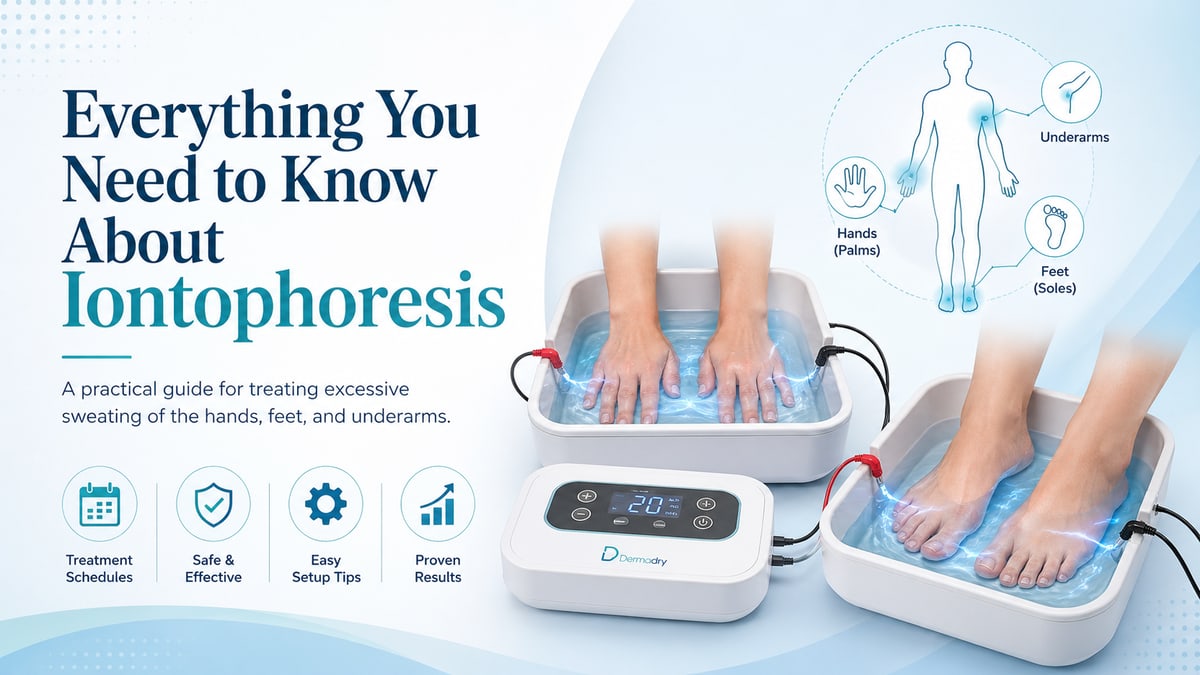
Iontophoresis is one of the strongest non-surgical options for focal hyperhidrosis, especially of the hands and feet. It also has a real role for underarms, and some consumer systems now market face, scalp, neck, chest, back, and other special-area accessories. The important reality is that the science is not equally strong everywhere: palmoplantar hyperhidrosis has the best evidence, axillary hyperhidrosis has less, and “full-body” or craniofacial use is still driven much more by specialist practice patterns, device ecosystems, and community experience than by robust comparative trials.1
The basic trade-off is simple: iontophoresis is safer, cheaper over time, and less invasive than Botox, microwave procedures, or surgery, but it is also more technique-dependent and it usually requires maintenance forever. If you are the kind of person who will actually stick to a routine, it can be outstanding. If you want a one-and-done treatment, it is not that.2a
What iontophoresis is best at
In practical terms, iontophoresis works best for people with primary focal hyperhidrosis of the palms and soles. That is where guidelines, review articles, and decades of clinical use line up most cleanly. Underarm sweating can also respond, but success becomes more dependent on having a well-designed pad or pocket system, good moisture distribution, and patient patience. For face, scalp, and odd body sites, the treatment is more “possible” than “standardized.”2b3a6
- Best fit: hands, feet, or both; people who want to avoid systemic side effects; people willing to do repeat sessions.
- Reasonable fit: underarms, especially if topical antiperspirants are not enough and you want to avoid oral drugs or injections.
- Possible but more niche: face, scalp, neck, chest, back, buttocks, or other local areas with specialty adapters or masks.
- Less attractive fit: people who cannot tolerate routine maintenance, or who have major contraindications to electrical treatment.
Published and clinical schedules vary, but the broad pattern is consistent: an initial “loading” phase of repeated sessions, then a maintenance phase tailored to relapse speed. Most failures are not true biologic failures. They are schedule failures, water/mineral problems, inadequate current, poor pad setup, untreated fungal irritation, or missed sweat zones like fingertips and thumb edges.4a7a
What to expect by body area
| Body area | How well iontophoresis usually fits | What usually matters most | Reality check |
|---|---|---|---|
| Palms | Excellent candidate | Consistency, enough current, full coverage of sweating surfaces | Often the most life-changing use case; evidence is strongest here. |
| Soles | Very good candidate | More patience, usually stronger settings than hands, treating athlete’s foot if present | Feet often need more power because plantar skin is thicker. |
| Underarms | Good candidate with the right system | Pad moisture, contact, comfort, lower current, not letting pads dry out | Works for many people, but technique sensitivity is higher. |
| Fingertips / thumb sides | Common “partial-response” trouble spot | Coverage tricks, water level, selective immersion, gloves/socks in some cases | Often the last area to get dry and the first to relapse. |
| Face / scalp / neck / other local areas | Specialty territory | Dedicated accessories, lower tolerance, careful setup, ideally expert guidance | The device may support it, but the evidence base is much thinner. |
Severity mainly changes how long the initial phase takes. Mild disease may respond in a week or two. Moderate disease often takes a few weeks. Severe “dripping” disease can still respond, but you should expect a longer loading phase, more trial-and-error around water quality and current, and a stricter maintenance rhythm once you finally get dry.4b7b
Consumer device guide
Important note before the table: the device market is messy. A 2024 market review found 11 iontophoresis devices being marketed online for hyperhidrosis in the United States, and the authors explicitly warned that class II clearance / substantial-equivalence language is not the same thing as strong comparative clinical testing of marketing claims. In other words: “FDA-cleared” matters, but it does not mean one brand’s dramatic superiority advertising is automatically true.9
Another note: prices move constantly, distributor pricing differs by region, and some brands lean heavily on temporary discounts or insurance workflows. The table below covers the main home-use devices I could directly verify online, with prices as checked on 2026-04-28. If a company did not publish a straightforward cash price, I say so.
| Device | Areas | Public price checked | Review link | Straight take |
|---|---|---|---|---|
| Hands / feet; underarms; all-in-one | $308.75 / $292.50 / $325 | Trustpilot | The cleanest mainstream value play right now. Good support footprint, simple ecosystem, and the cheapest major all-in-one price I could verify directly. | |
| Hands / feet / underarms | Not publicly posted; insurance / quote model | Trustpilot | Serious U.S. incumbent with a strong support reputation and insurance-heavy workflow. Main downside is weaker price transparency than retail-style competitors. | |
| Hands / feet; all-in-one; underarms | $875 / $915 / $695 | Official product reviews on product pages | Premium U.S. option for people who want a more configurable machine and do not mind paying up. Much pricier than Dermadry. | |
| Hands / feet; underarms | $253 / $237 | Official product pages | Budget-friendly legacy option with long brand history and an old clinical study behind it. Feature set is lighter and the public review trail is thinner than the major newer brands. | |
| Iontocure iD-200 | Hands / feet | $269 | Official product page with on-page reviews | Very low-entry-cost option. Attractive if money is the main filter, but brand transparency and verification depth are not as strong as the better-known medical players. |
| Hidrex ClassicION | Hands / feet; underarms packages available | £479 hands/feet; £499 hands/feet/underarms | IontoCentre | Good “pro-grade without going all the way upscale” choice if you specifically want direct-current capability and a simpler Hidrex path. |
| Hands / feet; underarms; face; specialty areas with accessories | £579 hands/feet; £599 hands/feet/underarms; £619 face; 714€ on Bindner store | Bindner on-page reviews | Probably the most configurable mainstream system I could verify. Great if you enjoy tuning settings and want a serious long-term machine, overkill if you just want simple and cheap. | |
| Hands / feet; underarm add-ons available through distributor ecosystem | 655€ (5 PS); 494€ (5 DC) | Bindner on-page reviews | Good German workhorse line. The 5 PS is the safer default for most people; the 5 DC is the bare-bones direct-current route. | |
| Hands / feet; underarms; face / forehead / neck with dedicated accessories | 689€ DE set; 664€ AX set; 129€ face accessory; 89€ forehead; 89€ neck | Official shop pages; I did not find an obvious public English-language review module | One of the clearest special-area ecosystems I could verify directly. Strong option if face/forehead/neck matters to you, but it is not cheap. | |
| Hands / feet / armpits / face | Monthly financing from €40 visibly published; outright pricing was not clearly public on the pages I checked | Official reviews | Interesting special-area option with a solid amount of on-page social proof. Main weakness is price transparency. | |
| Hands / feet / underarms in the base package; many special-area adapters sold separately | $499 Forte; $1,016 Elite; Sensitive PRO pricing rendered inconsistently on official pages | Official reviews / Trustpilot | Aggressive “anywhere on the body” ecosystem with lots of adapters and huge internal review counts. I would discount the marketing claims heavily and judge it mainly on whether you truly need those accessories. |
My blunt buying advice: if you only need hands and feet and want to keep cost reasonable, Dermadry is the easiest mainstream recommendation. If insurance can materially reduce your cost in the U.S., The Fischer becomes more attractive. If you want a more configurable “buy once, cry once” machine, Hidrex ComfortION and the upper-end German ecosystem are more compelling. If you need face, forehead, scalp, or other unusual zones, the best-verified ecosystems I could confirm were Saalio, Hidrex accessory lines, Hidroxa, and Electro Antiperspirant.
Schedules, treatment length, and strength
There is no single magic protocol. The best way to think about settings is:
- Use the device’s region-specific profile.
- Start low enough to learn the feel.
- Climb to the highest comfortable current.
- Repeat often enough during the loading phase to reach dryness.
- Back off only after you are actually dry.
Clinical studies and hospital guidance commonly land in the same general zone: 3 to 5 sessions per week at first, sessions around 15 to 30 minutes depending on protocol and body area, then individualized maintenance once sweating is controlled.3b4c5a
| Area | Reasonable starting frequency | Usual session length | Current guidance | Maintenance expectation |
|---|---|---|---|---|
| Hands | 3 to 5 times weekly | 15 to 20 minutes on many home units; some clinical protocols are longer | Highest comfortable current; on many mA-based home units people land around 10 to 15 mA | Often weekly, sometimes every 2 to 4 weeks if you are lucky |
| Feet | 3 to 5 times weekly | 15 to 20 minutes on many home units | Usually stronger than hands; thick plantar skin often needs more power | Commonly weekly or as-needed, but relapse is variable |
| Underarms | 3 to 5 times weekly at first | Roughly 10 to 20 minutes depending on system | Lower than hands/feet; comfort and pad moisture matter more | Every 1 to 3 weeks is common once controlled |
| Face / scalp / special areas | Accessory-specific | Accessory-specific | Follow manufacturer instructions exactly; tolerance is usually lower | Highly individual |
A good practical schedule for most people is:
- Phase 1: 3 to 5 sessions per week until sweating clearly drops.
- Phase 2: once dry, step down to every 3 to 4 days for a week or two.
- Phase 3: move to maintenance: weekly for many people, every 2 to 4 weeks for some, and several times weekly for the unlucky minority.
For Dermadry specifically, the manufacturer’s older instructions are a useful reference point: hands 1 to 15 mA for 20 minutes, feet 1 to 25 mA for 20 minutes, underarms 1 to 8 mA for 15 minutes, all with automatic polarity changes. Their schedule guidance scales the loading phase by severity, from about 1 to 2 weeks for mild disease up to 4 to 6 weeks for severe disease.7c
Two important caveats:
- If your device shows volts rather than mA, do not compare your number directly to somebody else’s. Devices and body resistance differ.
- Do not confuse “more” with “better.” Very long aggressive sessions can buy you irritation, cuts, and noncompliance instead of better control.
Water, baking soda, salt, glycopyrrolate, and other permutations
Plain tap water
Plain tap water is still the default first move and the standard recommendation in most mainstream instructions. It is simple, cheap, and often enough.5b7d
Soft water / low-mineral water
Soft water is one of the classic reasons iontophoresis underperforms. If you barely feel current, or you are doing everything “right” and getting nowhere, low mineral content is near the top of the suspect list. The usual evidence-backed fixes are:
- switch to non-carbonated mineral water, or
- add about a teaspoon of baking soda per tray.
That is the first “permutation” I would try on a real failure case, long before I started improvising with more exotic additives.2c7e
Warm water
Warm or room-temperature water is fine and often more comfortable. It also tends to make people less tense, which matters because tensing up and yanking your hands or pads around makes treatment worse.7f
Distilled or demineralized water
Bad idea as your main treatment water. It is too low in minerals and works against the point.5c
Baking soda
Baking soda is the cleanest, most mainstream conductivity hack. It is not glamorous, but it is the best first tweak in soft-water situations. Downsides: some people find it more drying or more irritating than plain tap water.2d12a
Mineral water, including S.Pellegrino-type community hacks
This is where the Reddit community gets interesting. A repeated anecdotal theme is that higher-mineral bottled water can change everything for people living in soft-water areas. S.Pellegrino and Gerolsteiner come up a lot. I would frame that as plausible community experience, not settled clinical science. Also note that manufacturers more commonly recommend non-carbonated mineral water, not sparkling water as such.12b13
Salt and Epsom salt
These circulate widely in anecdotal forums. Some people swear they help. The problem is that they are much less standardized, easier to overdo, and more likely to irritate or dry out skin. If you want to adjust conductivity, baking soda or a switch to mineral water is the cleaner first move. I would treat salt as a second-tier experiment, not a standard recommendation.12c
Glycopyrrolate / glycopyrronium in the water
This is the most important escalation option, but it is also where people start drifting from “simple home routine” into “drug delivery.” The clinical logic is real: studies and specialist practice support glycopyrrolate-augmented iontophoresis for stubborn palmoplantar cases, and hospital leaflets still describe it. The downsides are also real: dry mouth, dry throat, blurred vision, urinary symptoms, systemic anticholinergic effects, and the fact that some device manuals explicitly say their home device is not intended for drug delivery.7g810
My view is simple: if plain-water iontophoresis has genuinely plateaued, clinician-directed glycopyrrolate iontophoresis is a reasonable next rung. Self-experimenting with crushed tablets in trays because Reddit said so is understandable, but medically it is still off-label and more risky than water-only treatment.
Aluminum chloride or other add-ins
Older combination strategies exist in the literature, but for a modern consumer article the only permutations that matter much in practice are:
- plain tap water,
- tap water plus baking soda,
- non-carbonated mineral water,
- clinician-directed glycopyrrolate iontophoresis.
Everything else is fringe, more irritating, less standardized, or both.
Tips and troubleshooting
- Consistency beats hero sessions. The most common community success stories involve steady repetition, not random marathon treatments.
- Ramp up to the highest comfortable current. Too timid is usually worse than too low for a day or two. Your effective setting is the highest one you can repeat consistently.
- Do not drown the treatment area. Use enough water to cover the sweating surface, but do not unnecessarily flood trays if it makes coverage less targeted.
- Remove jewelry and keep the barrier material in place. Do not let skin touch bare electrodes.
- Cover small cuts with petroleum jelly. This is mainstream advice and it also shows up constantly in user experience threads. Just remember that skin under the barrier will not be treated well, so use it sparingly and precisely.
- If it stings badly, inspect your skin before blaming the machine. Tiny paper cuts, cuticle cracks, eczema, and maceration are classic culprits.
- If treatment “doesn’t work,” check water minerals, cable seating, pad moisture, electrode corrosion, and fungal infection before giving up.
- Fingertips need special attention. Lower water level, increase fingertip coverage, selectively immerse fingertips, or try damp cotton gloves/socks if your problem is missed edges rather than pure fingertip intensity. This is one of the most common Reddit pain points.
- Temporary worsening at the start is common. Many users report a brief “it got worse before it got better” period. That alone is not a reason to quit if the skin otherwise looks okay.
- Moisturize after treatment, not before. Dryness and scaling are common. Never start a session with lotion, cream, deodorant, or antiperspirant still sitting on the target skin.
- Underarm pads must stay wet enough. If they dry out mid-session, your comfort and current spread both get worse.
- Track your sessions. The difference between “iontophoresis does not work for me” and “I finally cracked it” is often just discovering your personal maintenance interval.
Safety, contraindications, and when to escalate
Home manuals and patient leaflets are pretty consistent about the big contraindications. In general, do not use iontophoresis if you have:
- a pacemaker or implantable cardioverter-defibrillator,
- known arrhythmia or significant heart disease,
- epilepsy / seizure disorder,
- pregnancy or suspected pregnancy,
- metallic implants in the current path,
- a metal-containing IUD,
- large skin lesions you cannot protect,
- infection, marked irritation, or impaired sensation in the treated area.
Short-term side effects are usually local and manageable: tingling, stinging, dryness, redness, mild burning, small blisters, transient numbness, or a brief early increase in sweating. That is the normal side-effect band. Once you move into severe pain, major erosions, obvious medication side effects, or chest / neurologic symptoms, you are outside the “normal annoyance” zone and should stop and reassess.7h
A sensible escalation ladder looks like this:
- plain-water iontophoresis done properly,
- water-quality optimization,
- device / coverage troubleshooting,
- clinician-directed glycopyrrolate iontophoresis if needed,
- then consideration of other treatments such as Botox, oral anticholinergics, or procedure-based options if iontophoresis remains inadequate.
My bottom line: for palmoplantar hyperhidrosis, iontophoresis is still one of the best deals in the whole treatment ladder. For underarms it is worth a serious trial if you want to avoid injections or oral medication. For special areas it can absolutely be worth trying, but I would trust accessory design and support quality more than sweeping “works anywhere on the body” marketing language.
Footnotes
- Practical review / overview material emphasizing the stronger evidence base for palmoplantar disease and the thinner evidence for some other uses: Solish MJ et al. A Practical Approach to the Diagnosis and Treatment of Hyperhidrosis (2022); DermNet NZ: Iontophoresis. ↩
- International Hyperhidrosis Society overview of iontophoresis, including practical notes on maintenance, soft water, and escalating with anticholinergic additives: IHHS: Iontophoresis. a c d
- Representative clinical evidence: Siah TW, Hampton PJ. Dermatology Online Journal (2013); Akins DL et al. Drionic study (1987); PubMed entry for Monday/Wednesday/Friday schedule. a b
- Baylor College of Medicine patient guidance: three treatments weekly until controlled, average around 10 initial treatments, then maintenance often every 2 to 4 weeks: Baylor: Iontophoresis for Excessive Sweating. a b c
- DermNet NZ overview, including the note that tap water is standard and distilled water is not the usual choice: DermNet NZ: Iontophoresis. a b c
- British Association of Dermatologists patient leaflet: BAD / Skin Health Info: Iontophoresis for Hyperhidrosis. ↩
- Dermadry Instructions for Use, including contraindications, treatment profiles, severity-based schedule guidance, “do not add products or drugs to the water,” use of petroleum jelly on small lesions, side effects, and troubleshooting: Dermadry IFU PDF. a b c d e f g h
- Glycopyrrolate-augmented iontophoresis: Dolianitis C et al. Australasian Journal of Dermatology (2004); UHD NHS leaflet on glycopyrrolate iontophoresis. ↩
- Device-market caveat: Peichi Chou et al. “Selecting an Iontophoresis Device: A Source of Consternation” poster; JAAD publication page (2024). ↩
- Hospital / guideline pathways still recognizing glycopyrrolate solution in iontophoresis practice: South East London hyperhidrosis treatment pathway; NHS Tayside formulary entry. ↩
- Mainstream device links / pricing pages used to build the buyer table: Dermadry, RA Fischer, Hidrex USA, Drionic, Iontocure, IontoCentre, Bindner Medical, Saalmann Medical Shop, Hidroxa, and Electro Antiperspirant official sites.
- Reddit community themes on water tweaks, salt, and conductivity: “Share your Iontophoresis successful treatment plans!”; “Iontophoresis + San Pellegrino is God send!”; “Tips for iontopheresis?”; “Ionto + SP water”. a b c
- More Reddit experience on mineral-water success and maintenance: “Iontophoresis no longer effective”; “Best Maintenance schedule for IONTO”; “How often do you do iontophoresis for maintenance?”. ↩
- Reddit experience on cuts, petroleum jelly, and treatment pain: “Iontophoresis Hurt with cuts”; “Some questions for those who have used iontophoresis”; “Iontophoresis caused some cuts on my hands”.
- Reddit experience on fingertips and coverage problems: “Tips for Stubborn Fingertips in Iontophoresis?”; “Tips of fingers with ionto”; “Tips for fingers (back of fingers too) while using Dermadry?”.
- Reddit experience on transient worsening: “Does sweating get worse when first start using iontophoresis”; “My Iontophoresis Experience”; “Iontophoresis?”.