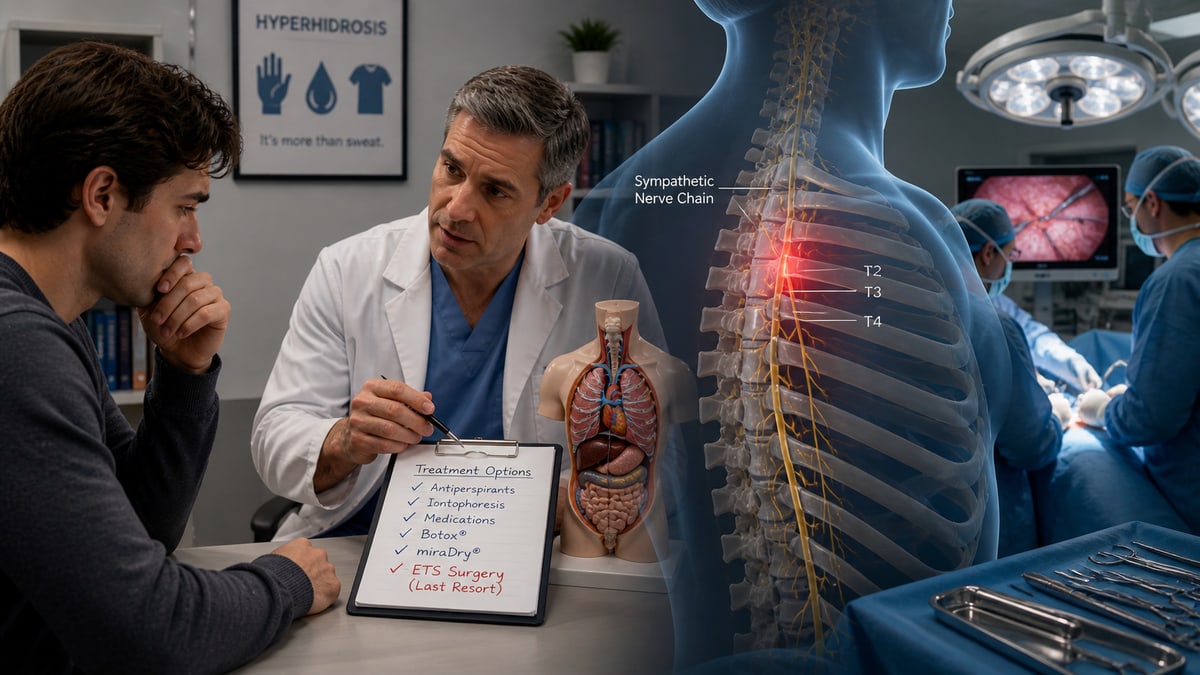
A plain-language place to start
ETS surgery is one of the most serious treatment decisions in hyperhidrosis care. It can help some people, especially those with severe palmar hyperhidrosis, but it also carries risks that are very different from trying an antiperspirant, iontophoresis, Botox, or oral medication.
If you are reading this because you are desperate, I understand that. Severe sweating can take over parts of your life that other people barely think about: shaking hands, writing, dating, work, school, clothing, touch, driving, tools, phones, and just sitting somewhere without feeling watched. Hyperhidrosis can seriously affect quality of life, emotional well-being, and daily functioning.1
But desperation is exactly why ETS needs a careful discussion. When a treatment promises something permanent, it can sound like relief. With ETS, “permanent” can be the point, but it can also be the problem.
The most important message is this: ETS is generally a last-resort option, not a normal early step. It should be considered only after safer and more reversible treatments have been tried seriously, adjusted properly, and still have not given enough relief.
What ETS surgery is
ETS stands for endoscopic thoracic sympathectomy. It is a surgery that interrupts part of the sympathetic nerve chain inside the chest. The sympathetic nervous system helps control sweating. By cutting, cauterizing, clipping, or otherwise interrupting selected parts of that nerve pathway, the surgery aims to reduce sweating in the target area, usually the hands.2
“Endoscopic” means the surgeon uses small incisions and a camera instead of a large open incision. “Thoracic” means the surgery is done in the chest. “Sympathectomy” or “sympathicotomy” refers to interrupting or destroying part of the sympathetic nerve pathway.
The surgery is usually performed under general anesthesia. A surgeon makes small incisions under the arm, inserts a camera into the chest, temporarily deflates part of the lung on that side to create space, identifies the sympathetic nerve chain, and interrupts the nerve pathway. The process may be repeated on the other side.3
Different surgeons may use different techniques:
- Sympathectomy: removal or destruction of part of the sympathetic chain or ganglia.
- Sympathicotomy / sympathotomy: cutting or interrupting the sympathetic trunk.
- Clipping: placing clips on the sympathetic chain rather than cutting or removing it.
- Different levels: operating around T2, T3, T4, or other levels depending on symptoms and surgical approach.
These differences matter. The level and extent of interruption may affect both symptom control and side effects, especially compensatory sweating.4
The current landscape: why ETS is treated with caution
ETS is not viewed the same way everywhere. Some thoracic surgeons consider it an effective option for carefully selected patients with severe palmar hyperhidrosis. Many dermatology and hyperhidrosis-focused resources stress caution because the side effects can be severe, persistent, and hard or impossible to reverse.
NICE guidance says the evidence for ETS in primary hyperhidrosis of the upper limb is adequate to support use with normal arrangements for governance, consent, and audit, but it also states that patients must be clearly told about serious complications, that sweating elsewhere on the body is usual after the procedure and can be severe and distressing, and that some patients regret the surgery. NICE also says ETS should only be considered for severe, debilitating primary hyperhidrosis that has not responded to other treatments.5
The International Hyperhidrosis Society describes ETS as the most invasive treatment for hyperhidrosis and says most clinicians reserve it for severe symptoms after more conservative treatment has failed and only when patients fully understand the risks of common and severe compensatory sweating.2
That is the current landscape in plain English: ETS can work, especially for severe hand sweating, but the risk profile is serious enough that it should not be treated as just another box to check.
Who ETS may help
ETS is most often discussed for people with severe palmar hyperhidrosis, meaning excessive hand sweating. This is the area where ETS has the strongest history of effectiveness.
ETS may be considered when:
- hand sweating is severe and disabling
- symptoms have a major impact on work, school, touch, safety, tools, writing, or daily function
- the sweating pattern is consistent with primary focal hyperhidrosis
- non-surgical treatments have been tried seriously and have failed or are not tolerated
- the person understands the possibility of compensatory sweating and other complications
- the person understands that the result may not be reversible
ETS is less straightforward for underarm sweating, facial/scalp sweating, and mixed patterns. NICE notes that the primary indication is palmar hyperhidrosis, while axillary hyperhidrosis often coexists but is seldom the primary reason for using the procedure because benefit is less assured.6
Who should be especially careful
Everyone should be careful with ETS, but some situations deserve extra caution.
- Isolated underarm sweating: Local underarm treatments are usually more appropriate to exhaust first.
- Plantar-only sweating: ETS is not designed for feet; the feet are controlled by lower sympathetic pathways, and surgery for plantar sweating is rarely done because of risk concerns.7
- Generalized sweating: Whole-body sweating should be evaluated for secondary causes before considering any surgical approach.
- Heat-sensitive lifestyle: Outdoor work, athletics, hot climates, saunas, intense exercise, or jobs in hot environments may make compensatory sweating and heat intolerance especially important.
- High fear of compensatory sweating: If the idea of sweating heavily from your trunk, back, abdomen, groin, thighs, or legs would feel worse than your current symptoms, that matters.
- Expectation of guaranteed reversal: Clipping is sometimes described as more reversible, but reversal is not guaranteed and symptom improvement after clip removal varies.
ETS should not be used to escape the discomfort of trying other treatments. It should be considered only when the severity of the original sweating and the failure of other options justify taking on a different kind of risk.
How the procedure usually works
ETS is a thoracic surgery. It is not a skin procedure. It is not the same category as miraDry, Botox, topical wipes, or local underarm sweat gland procedures.
A typical process may include:
- Pre-surgical evaluation: Review of symptoms, prior treatments, medical history, lung/heart risk, and whether the sweating pattern is appropriate for ETS.
- General anesthesia: You are asleep for the surgery.
- Small chest incisions: Usually under the arm or along the side of the chest.
- Thoracoscope placement: A camera is inserted so the surgeon can see inside the chest.
- Temporary lung deflation: The lung on the surgical side may be deflated to create working space.
- Sympathetic chain interruption: The surgeon cuts, cauterizes, clips, or removes the targeted part of the sympathetic nerve pathway.
- Closure and recovery: The lung is reinflated, incisions are closed, and the patient is monitored after surgery.
MedlinePlus notes that the surgery often takes about 1 to 3 hours, and some people stay in the hospital overnight and go home the next day. Pain may last a week or two, and normal activity is resumed gradually according to the surgeon’s instructions.3
Potential benefits
ETS can be very effective at stopping or greatly reducing sweating in the target area, especially the hands. For someone with severe palmar hyperhidrosis, that can feel life-changing.
Potential benefits may include:
- dry or much drier hands
- better ability to write, type, use tools, or handle paper
- less fear of handshakes or touch
- less damage to electronics, paperwork, or work materials
- improved confidence in some social and professional situations
- long-lasting reduction in the treated area
Some long-term studies report high satisfaction in many patients, especially when the original problem was severe palmar sweating. But satisfaction statistics do not erase the reality that a meaningful minority of patients develop serious side effects or regret. Both things can be true at the same time.
Risks and side effects
ETS has the usual risks of anesthesia and surgery, plus risks specific to operating inside the chest and altering the sympathetic nervous system.
Reported risks and side effects include:
- compensatory sweating
- gustatory sweating, meaning sweating triggered by eating
- overly dry hands
- heat intolerance
- pneumothorax, meaning air around the lung
- hemothorax, meaning blood in the chest
- bleeding
- infection
- chest pain or nerve pain
- Horner syndrome, which can include eyelid drooping and reduced facial sweating
- slow heart rate or other heart rhythm issues
- rhinitis or nasal symptoms
- recurrence or incomplete relief
- rare serious complications, including major bleeding, cardiac arrest, or death
NICE reviewed safety reports that included compensatory hyperhidrosis in large case series, pneumothorax requiring drainage, Horner syndrome, bleeding, cardiac arrest case reports, heatstroke, gustatory sweating, persistent bradycardia, pulmonary complications, and rare deaths reported in the literature.8
That does not mean every person will experience severe complications. Many people do not. But before choosing ETS, you need to understand the full risk range, not only the best-case outcome.
Compensatory sweating
Compensatory sweating is the main reason ETS is controversial. It means sweating decreases in the treated area, but increases somewhere else, often the trunk, back, abdomen, chest, thighs, groin, or legs.
Mild compensatory sweating may be tolerable. Severe compensatory sweating can be life-altering. Some people feel that ETS solved their hands but created a larger and more difficult sweating problem somewhere else.
The International Hyperhidrosis Society reports that compensatory sweating is the most common complication after ETS, with an average rate around 60% and a published range from 3% to 98%. It also notes that severe compensatory sweating has been reported in 10% to 40% of patients, and that longer-term follow-up studies have shown persistent symptoms for some people.9
NICE reported compensatory hyperhidrosis rates of 92%, 86%, and 74% in three case series, with severe or incapacitating compensatory hyperhidrosis reported by 33% in two of those studies.8
This is the part to sit with. Not skim. Not rationalize away. If ETS works, you may get the dry hands you wanted. But you may also develop sweating elsewhere that is harder to hide, harder to treat, and possibly more upsetting.
Common areas for compensatory sweating
- back
- chest
- abdomen
- groin
- buttocks
- thighs
- legs
Important realities
- It can appear soon after surgery or develop later.
- It can be mild, moderate, severe, or disabling.
- It may persist long term.
- It can be difficult to predict who will get the severe version.
- There is no guaranteed fix once it happens.
A 2023 systematic review on surgical management of compensatory sweating noted that treatment options for compensatory sweating are limited, evidence is sparse, and results are uncertain. Surgical approaches such as clip removal, extended sympathectomy, and sympathetic chain reconstruction have been reported, but reliable solutions are not established.10
Levels, techniques, and the “safer ETS” question
Some modern ETS discussions focus on reducing risk by operating at different levels, limiting the extent of nerve interruption, or using clipping instead of cutting. These details matter, but they do not remove the need for caution.
A systematic review and meta-analysis comparing different denervation levels for palmar hyperhidrosis found that lower or more limited levels, especially T4 compared with T3 or T2 in some comparisons, were associated with lower risks of compensatory sweating, moderate-to-severe compensatory sweating, dry hands, and gustatory sweating, without major loss of symptom resolution in the included studies.11
This supports the idea that technique matters. It does not mean ETS has become risk-free.
Clipping is sometimes marketed as reversible. That needs careful wording. Clip removal can help some people, especially if done early, but it does not reliably reverse all side effects. In one large study of thoracoscopic sympathetic clipping, 34 patients underwent clip removal after adverse effects; among those with follow-up, 48% reported a substantial decrease in compensatory sweating after reversal.12
In other words: clipping may preserve the possibility of reversal in some cases, but it should not be treated like an undo button.
Body-area guide
| Body area | How ETS fits | Practical caution |
|---|---|---|
| Hands / palms | Most established use case. ETS can be highly effective for severe palmar hyperhidrosis. | Still requires caution because compensatory sweating may be worse than expected. |
| Underarms | Can be affected by ETS, especially when underarm sweating coexists with hand sweating. | Benefit is less assured for isolated axillary sweating. Local treatments are usually preferred first. |
| Face / scalp | Sometimes discussed, especially for severe facial sweating or blushing. | Risk of severe compensatory sweating and other side effects may be higher; decision should be especially cautious. |
| Feet / soles | ETS does not directly target plantar sweating. | Foot sweating is controlled by lower sympathetic pathways; surgery for plantar sweating is rarely done because of risk concerns. |
| Back, chest, trunk, groin, thighs | Not target areas for ETS treatment. | These are common areas where compensatory sweating may appear after ETS. |
| Generalized sweating | ETS is usually not appropriate. | Generalized sweating should be evaluated for secondary causes and managed medically. |
Treatments to exhaust before ETS
Before considering ETS, it is worth making sure other treatments have been tried properly. Not casually tried once. Properly tried, adjusted, and combined where appropriate.
Options to discuss before ETS include:
- Prescription-strength antiperspirants: especially aluminum chloride products, used correctly on dry skin.
- Topical anticholinergics: such as glycopyrronium cloths for underarms or compounded glycopyrrolate for certain areas.
- Iontophoresis: especially for hands and feet; often underused or abandoned before troubleshooting water quality, schedule, current level, and maintenance.
- Botulinum toxin injections: especially for underarms and hands, though palmar injections can be painful and may temporarily weaken grip.
- Oral medications: such as glycopyrrolate or oxybutynin, if appropriate and tolerated.
- miraDry or other local underarm procedures: for axillary hyperhidrosis, when underarms are the main issue.
- Local underarm surgery: such as curettage or sweat gland removal procedures for refractory axillary sweating.
- Combination therapy: using lower-risk treatments together, such as iontophoresis plus oral medication, or Botox plus topical support.
NICE lists first-line and non-surgical options such as lifestyle measures, antiperspirants, iontophoresis, botulinum toxin A, and oral medications before surgical options are considered.13
If a clinician is recommending ETS before carefully reviewing these options, that is a reason to slow down and seek another opinion.
Questions to ask before considering ETS
If you are seriously considering ETS, bring a written list of questions. A good surgeon should be willing to discuss the risks plainly and should not rush you through consent.
About whether you are a candidate
- Is my sweating pattern appropriate for ETS?
- Is this mainly for palmar sweating, or are we trying to treat another area?
- Have I truly exhausted safer and reversible treatments?
- Should I be evaluated for secondary causes of sweating before surgery?
- Would you recommend ETS if my main symptom were underarm, facial, scalp, or foot sweating?
About the surgeon and technique
- How many ETS procedures have you performed for hyperhidrosis?
- What level do you operate at: T2, T3, T4, or another level?
- Do you cut, cauterize, remove, or clip the sympathetic chain?
- Why do you prefer that approach for my case?
- What is your personal rate of compensatory sweating?
- What is your rate of severe compensatory sweating?
- What is your recurrence or failure rate?
- How do you define “success”?
About side effects
- What compensatory sweating patterns should I expect?
- How often do your patients regret the surgery?
- What side effects have caused the most dissatisfaction in your patients?
- What happens if I develop severe compensatory sweating?
- Is there any reliable reversal option?
- What are the risks of Horner syndrome, pneumothorax, bleeding, chronic pain, bradycardia, or heat intolerance?
About recovery and life afterward
- How long is recovery?
- Will I need a chest tube?
- When can I return to work, school, exercise, or driving?
- How should I handle heat exposure after surgery?
- What follow-up do you provide if side effects appear months later?
About informed consent
- Can you give me written information on risks and complications?
- Can I speak with both satisfied and dissatisfied patients?
- Can I take time to decide?
- Would you support me getting a second opinion?
If you feel pressured, dismissed, or told not to worry about compensatory sweating, pause. That is not the kind of decision that should be made under pressure.
Decision table
| Question | ETS may be more reasonable if... | ETS may be too risky or premature if... |
|---|---|---|
| How severe is the sweating? | It is severe, disabling, and affects daily function. | It is distressing but not yet fully treated with safer options. |
| Where is the sweating? | The main problem is severe palmar hyperhidrosis. | The main problem is isolated underarm, foot, trunk, or generalized sweating. |
| Have other treatments been exhausted? | You have seriously tried appropriate non-surgical treatments and combinations. | You have not yet tried iontophoresis, Botox, oral meds, prescription topicals, or local options where appropriate. |
| Do you understand compensatory sweating? | You understand it may be common, severe, persistent, and difficult to treat. | You are assuming it will be mild or reversible. |
| Are you comfortable with permanence? | You accept that reversal may not be possible or reliable. | You are choosing clipping because you believe it guarantees an undo option. |
| Have you had multiple opinions? | You have spoken with an experienced thoracic surgeon and ideally a hyperhidrosis-focused dermatologist. | You have only heard from a surgeon who mainly emphasizes success rates. |
| Can you tolerate the worst plausible outcome? | You have thought seriously about severe trunk/groin/leg sweating and still feel the risk may be worth it. | Severe compensatory sweating would feel unbearable or worse than your current symptoms. |
The emotional side of the decision
ETS can be emotionally complicated because severe hyperhidrosis can make people desperate for permanence. That desperation is understandable. When your hands are soaked every day, “permanent dry hands” can sound like freedom.
But a good decision is not made from panic. It is made from clear information, realistic expectations, and enough time to think.
Before deciding, try asking yourself:
- Am I choosing this because I have no other reasonable options, or because I am exhausted and want the fastest escape?
- Have I heard from people who regret ETS, not only people who are happy with it?
- Do I understand what severe compensatory sweating could look like in my actual life?
- Have I tried the best version of non-surgical treatments, or only the easiest version?
- If I developed worse sweating elsewhere, would I still feel the original trade-off was worth it?
- Am I being rushed?
None of these questions are meant to scare you away from every possible surgical option. They are meant to protect you from making a permanent decision while feeling cornered.
What a good consultation should feel like
A good ETS consultation should feel careful, not salesy.
A responsible clinician should:
- confirm the diagnosis and sweating pattern
- review previous treatments in detail
- explain why ETS is or is not appropriate for your body area
- give clear numbers from their own practice when possible
- talk openly about compensatory sweating
- discuss serious but less common risks
- explain recovery and follow-up
- provide written information
- encourage time for decision-making
- respect your interest in a second opinion
A concerning consultation might include:
- minimizing compensatory sweating
- promising reversal
- calling ETS “simple” without discussing chest surgery risks
- pushing surgery before reviewing non-surgical options
- not explaining the surgical level or technique
- not discussing long-term outcomes
- not providing written risk information
- making you feel foolish for asking hard questions
You are allowed to ask hard questions. This is your body, your sweating pattern, your risk, and your life afterward.
Final thought
ETS surgery can be life-changing in both directions.
For some people with severe palmar hyperhidrosis, it brings the relief they hoped for. Their hands become dry, daily tasks become easier, and the original sweating finally stops dominating their life.
For others, the surgery creates new problems: compensatory sweating, heat intolerance, gustatory sweating, dry hands, pain, regret, or symptoms that are harder to manage than the original hyperhidrosis.
That is why ETS belongs at the end of the treatment ladder, not the beginning. It deserves respect, caution, second opinions, and careful consent.
If you are considering it, you are not wrong for wanting relief. You just deserve the full picture before making a permanent decision.
Try everything reasonable first. Ask every uncomfortable question. Talk to more than one qualified clinician. Read both the success stories and the regret stories. Then decide from information, not desperation.
You deserve relief, but you also deserve protection from a treatment choice that cannot easily be undone.
Footnotes
- Parashar K, Adlam T, Potts G. “The Impact of Hyperhidrosis on Quality of Life: A Review of the Literature.” American Journal of Clinical Dermatology. 2023;24(2):187-198. DOI: 10.1007/s40257-022-00743-7. Available at: https://pmc.ncbi.nlm.nih.gov/articles/PMC9838291/. Also see Kamudoni P, Mueller B, Halford J, Schouveller A, Stacey B, Salek MS. “The impact of hyperhidrosis on patients’ daily life and quality of life: a qualitative investigation.” Health and Quality of Life Outcomes. 2017;15:121. DOI: 10.1186/s12955-017-0693-x. Available at: https://pmc.ncbi.nlm.nih.gov/articles/PMC5465471/. Back
- International Hyperhidrosis Society. “ETS Surgery.” The IHHS describes ETS as the most invasive hyperhidrosis treatment and notes that most clinicians reserve it for severe symptoms after conservative treatments fail and after patients understand the risks of common and severe compensatory sweating. Available at: https://www.sweathelp.org/treatments-hcp/ets-surgery.html. Back
- MedlinePlus. “Endoscopic thoracic sympathectomy.” MedlinePlus describes the general surgical process, including general anesthesia, small incisions, thoracoscope use, temporary lung deflation, nerve cutting/clipping/destruction, and typical recovery considerations. Available at: https://medlineplus.gov/ency/article/007291.htm. Back
- NICE. “Endoscopic thoracic sympathectomy for primary hyperhidrosis of the upper limb: Committee comments.” NICE notes that ETS techniques vary in how the sympathetic chain is handled and in the extent of sympathectomy, and that these variations may affect safety and efficacy outcomes. Available at: https://www.nice.org.uk/guidance/htg339/chapter/6-Committee-comments. Back
- NICE. “Endoscopic thoracic sympathectomy for primary hyperhidrosis of the upper limb: Recommendations.” NICE states that patients must understand risks, including serious complications, usual hyperhidrosis elsewhere on the body that can be severe and distressing, possible regret, and possible failure to reduce upper-limb hyperhidrosis. NICE also states that ETS should only be considered for severe, debilitating primary hyperhidrosis refractory to other treatments. Available at: https://www.nice.org.uk/guidance/htg339/chapter/1-Recommendations. Back
- NICE. “Endoscopic thoracic sympathectomy for primary hyperhidrosis of the upper limb: Committee comments.” NICE notes that the primary indication for ETS is palmar hyperhidrosis and that axillary hyperhidrosis is seldom the primary indication because benefit is less assured. Available at: https://www.nice.org.uk/guidance/htg339/chapter/6-Committee-comments. Back
- International Hyperhidrosis Society. “ETS Surgery.” The IHHS notes that feet are innervated by L2 to L4 and that sympathectomy for plantar symptoms is rarely done because sexual side effects can occur with ablation at that level. Available at: https://www.sweathelp.org/treatments-hcp/ets-surgery.html. Back
- NICE. “Endoscopic thoracic sympathectomy for primary hyperhidrosis of the upper limb: Safety.” NICE summarizes reported safety outcomes including compensatory hyperhidrosis rates, severe or incapacitating compensatory hyperhidrosis, regret/dissatisfaction, pneumothorax, hemothorax, Horner syndrome, cardiac arrest case reports, heatstroke, gustatory sweating, persistent bradycardia, and other adverse events. Available at: https://www.nice.org.uk/guidance/htg339/chapter/5-Safety. Back
- International Hyperhidrosis Society. “Complications.” The IHHS reports compensatory hyperhidrosis as the most common ETS complication, with an average rate around 60%, a range of 3% to 98%, and severe sweating reported in 10% to 40% of patients. Available at: https://www.sweathelp.org/treatments-hcp/ets-surgery/complications.html. Back
- Loizzi D, Mongiello D, Bevilacqua MT, et al. “Surgical management of compensatory sweating: A systematic review.” Frontiers in Surgery. 2023;10:1160827. DOI: 10.3389/fsurg.2023.1160827. The review notes that compensatory sweating is the most common and feared side effect of thoracic sympathectomy and that available treatments for compensatory sweating have limited evidence and uncertain results. Available at: https://pmc.ncbi.nlm.nih.gov/articles/PMC10073509/. Back
- Zhang W, Yu D, Wei Y, et al. “A systematic review and meta-analysis of T2, T3 or T4, to evaluate the best denervation level for palmar hyperhidrosis.” Scientific Reports. 2017;7:129. DOI: 10.1038/s41598-017-00169-w. This review found lower compensatory sweating and moderate-to-severe compensatory sweating with lower/restricted denervation levels in several comparisons, especially T4 compared with T3 or T2, while symptom resolution remained similar in included studies. Available at: https://www.nature.com/articles/s41598-017-00169-w. Back
- Sugimura H, Spratt EH, Compeau CG, Kattail D, Shargall Y. “Thoracoscopic sympathetic clipping for hyperhidrosis: long-term results and reversibility.” The Journal of Thoracic and Cardiovascular Surgery. 2009;137(6):1370-1376. DOI: 10.1016/j.jtcvs.2009.01.008. In patients who underwent clip removal after adverse effects, 48% reported a substantial decrease in compensatory sweating after reversal. Available at: https://pubmed.ncbi.nlm.nih.gov/19464450/. Back
- NICE. “Endoscopic thoracic sympathectomy for primary hyperhidrosis of the upper limb: Indications and current treatments.” NICE lists first-line and other treatments including lifestyle measures, antiperspirants, iontophoresis, botulinum toxin A injections, oral medications, and local surgical options before sympathectomy. Available at: https://www.nice.org.uk/guidance/htg339/chapter/2-Indications-and-current-treatments. Back