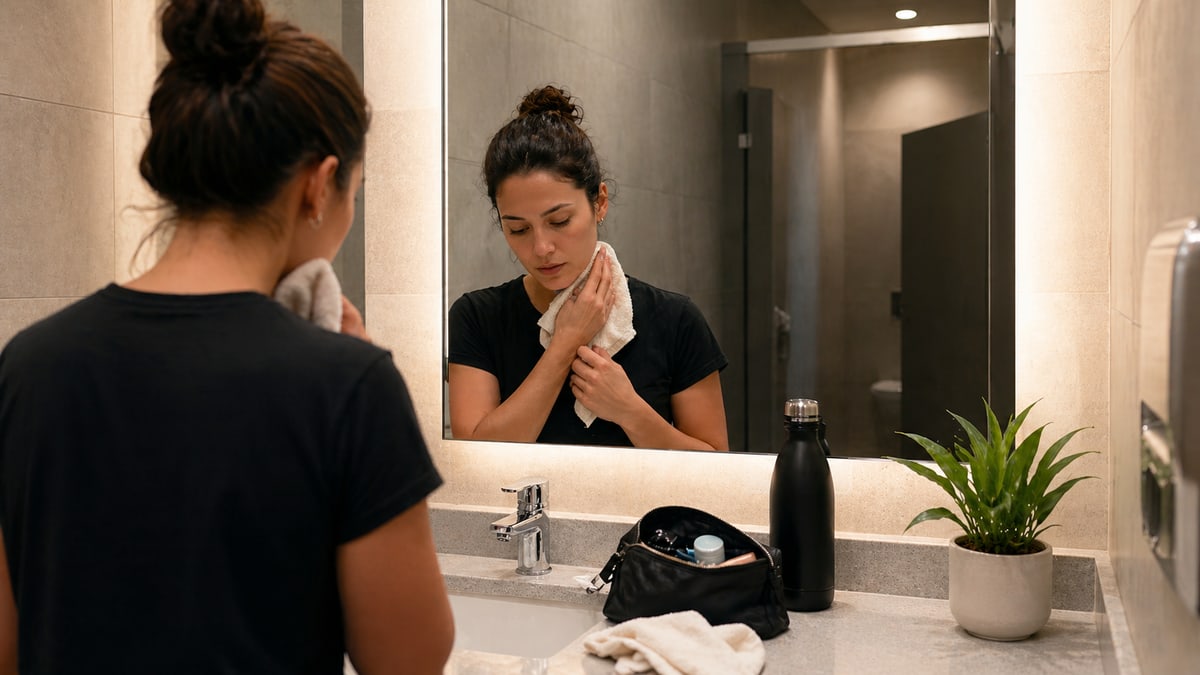
Why the reset can feel like failure
If you have hyperhidrosis, stepping away to the bathroom can feel heavier than it probably looks from the outside. To everyone else, you are just gone for a minute. To you, it might feel like proof that the night is going badly, your body is betraying you, and everyone can tell something is wrong.
I know that feeling. You are trying to stay present, but part of your mind is tracking your hands, underarms, face, scalp, back, shirt, socks, makeup, hair, or whatever area is flaring. You start wondering if the sweat is visible, if someone noticed, if you should leave, if you ruined the mood, or if you are being too much.
The bathroom becomes more than a bathroom. It becomes the place you go to check the damage.
But needing a reset does not mean you failed. It means you noticed what your body needed and gave yourself a chance to keep going.
Hyperhidrosis can affect emotional well-being, social life, daily routines, work, school, clothing choices, relationships, and confidence.1 So if a flare-up hits you emotionally, that makes sense. You are not just dealing with moisture on skin. You are dealing with the fear, memory, and self-consciousness that can come with it.
What a bathroom reset really is
A bathroom reset is a strategy. It is a small pause where you give yourself privacy, check what is actually happening, make one or two practical adjustments, and return without turning the whole outing into a crisis.
It can be as simple as:
- drying your hands
- wiping your face or neck
- checking a shirt or underarm area
- changing socks
- switching an undershirt
- taking a few slow breaths
- cooling down for a minute
- reminding yourself that you are still allowed to be there
That last one matters. The reset is not just physical. It is emotional. It is a way to stop the spiral before it decides the entire story for you.
You are not disappearing because you cannot handle life. You are taking a minute so you can stay in it.
When to step away
You do not have to wait until you are panicking. In fact, bathroom resets work best when you use them early, before your nervous system gets fully overwhelmed.
It may be time for a reset if:
- you keep checking your clothes, hands, or face
- you cannot focus on the conversation
- you feel the urge to leave suddenly
- your hands are making touch, writing, eating, or phone use hard
- your shirt, socks, or underlayers feel uncomfortable
- you feel overheated and need to cool down
- you are about to apologize repeatedly
- you need a private second to breathe
A reset does not have to mean something is wrong. It can just mean, “I am going to take care of this before it gets bigger.”
| What you notice | What it might mean | Helpful reset |
|---|---|---|
| You keep wiping your hands on your clothes | Your hands need a real dry-off, not a hidden panic wipe | Step away, dry your hands fully, and return with less tension |
| You are checking your shirt every few minutes | The uncertainty is taking over your attention | Check once privately, adjust if needed, then stop re-checking |
| Your face or scalp is dripping | You may need cooling and a soft towel, not self-criticism | Wipe gently, drink water, take slow breaths, cool down |
| Your socks or feet feel soaked | Discomfort may keep building until you address it | Change socks if you have them, or dry your feet if possible |
| You feel like you need to leave immediately | Your anxiety may be jumping ahead | Take one reset first, then decide what you actually need |
The three-minute reset
A reset does not need to be long. Sometimes three minutes is enough to keep the night from feeling like it is slipping away.
Minute one: take care of the obvious thing
Do the physical thing that needs doing first. Dry your hands. Wipe your face. Check the sweat mark. Change the shirt. Adjust the underarm pad. Swap socks. Drink water. Turn toward a fan or cooler air if there is one.
Keep it practical. You are not there to judge your body. You are there to help it.
Minute two: slow your body down
Take a few slow breaths. You do not need a perfect breathing technique. Just let your breathing become steadier than it was when you walked in.
Research on regulated breathing practices suggests that slow breathing can help reduce stress and anxiety for many people, although there is no single perfect protocol for everyone.2 For this kind of reset, the point is not to “cure” anxiety. The point is to give your body a signal that it is not in immediate danger.
Try this:
- Inhale gently for a count of four.
- Exhale slowly for a count of six.
- Repeat three to five times.
- Let your shoulders drop if they are tight.
- Unclench your jaw if you notice it.
Minute three: decide what happens next
Before you go back out, ask yourself:
- Do I need to change anything else?
- Do I need to say anything when I return?
- Can I go back and continue?
- Am I deciding based on the actual situation or based on fear?
You are allowed to leave if you truly need to. But a reset gives you a moment to decide from a steadier place instead of letting panic make the decision for you.
What to check while you are there
When you are anxious, it is easy to check everything. That can make you feel worse. A better reset is specific. Check what actually needs attention, make the smallest useful adjustment, and stop.
Hands
- Dry your palms and fingers fully.
- Use a cloth, towel, tissue, or wipe if you brought one.
- Check whether your phone, pen, or paper needs wiping.
- Remind yourself that wet hands do not mean the interaction is ruined.
Underarms
- Check once, not ten times.
- Change an undershirt or layer if you brought one.
- Use a wipe if it helps you feel fresh.
- Adjust pads or clothing if needed.
- Try not to punish yourself for visible sweat. It is a symptom, not a character flaw.
Face, scalp, and neck
- Use a soft towel or tissue to blot instead of rubbing harshly.
- Drink water if you feel overheated.
- Let yourself cool for a minute before returning.
- If you wear makeup or style your hair, fix only what actually needs fixing.
Feet
- Change socks if you have a pair with you.
- Dry your feet if possible.
- Put damp socks in a small bag.
- Do not treat wet socks as a reason the whole day is ruined.
Back, chest, groin, or trunk
- Change a base layer if you brought one.
- Use a wipe or towel if it helps.
- Give yourself a moment to cool down before putting layers back on.
- Use the most private, practical fix available and then return.
What to carry for easier resets
You do not need to carry your entire bathroom cabinet. A few small items can make resets much easier.
| Item | Why it helps | Best for |
|---|---|---|
| Small handkerchief or microfiber towel | Lets you dry hands, face, or neck without relying on paper towels | Hands, face, scalp, neck |
| Soft wipes | Helps you feel fresh after a flare-up | Underarms, hands, feet, body |
| Backup shirt or undershirt | Gives you an option if visible sweat marks are making you anxious | Underarms, chest, back |
| Extra socks | Can make feet feel much more comfortable after a flare-up | Feet |
| Small plastic bag or wet bag | Keeps damp clothes, socks, or towels separate | Any outing |
| Water bottle | Helps you cool down and gives you something simple to do while resetting | Heat-triggered sweating, face/scalp sweating, long outings |
| Antiperspirant or prescribed product | Useful if part of your routine, though many antiperspirants work best when applied before bed to dry skin | Underarms, hands, feet, depending on product |
Dermatology resources often recommend practical tools like antiperspirant, breathable clothing, moisture-wicking socks, absorbent supplies, and school or work supports for people with excessive sweating.3 The bathroom reset is where those tools become useful in real life.
Returning without spiraling
The hardest part is often not stepping away. It is coming back.
You may feel like everyone noticed how long you were gone. You may wonder if your face looks different, if your shirt is still marked, if someone thinks you are upset, or if the moment has changed.
Most of the time, people are not tracking you as closely as you think. And even if someone noticed you stepped away, that does not mean they are judging you.
Try giving yourself a return phrase before you walk back in:
“I took care of what I needed. I can rejoin the moment.”
Or:
“I do not have to explain unless I want to.”
Or:
“The reset helped. Now I can continue.”
When you return, do one normal thing quickly. Sit down. Pick up the conversation. Take a sip of water. Smile at the person you are with. Ask a question. Rejoin the activity. This teaches your brain that a reset is not an ending.
What to say if someone notices
You do not owe everyone an explanation. But sometimes having one calm sentence ready makes it easier to come back without feeling exposed.
If you want to keep it simple
“I just needed a quick reset. I’m good.”
If you want to mention sweating
“I deal with excessive sweating, so sometimes I step away for a minute. I’m okay.”
If someone asks if you are upset
“No, I’m not upset. I just needed a second to cool down.”
If you are with someone you trust
“I got self-conscious about sweating for a minute. I just needed to reset.”
If you do not want to talk about it
“I’m okay, just needed a minute. Let’s keep going.”
A short sentence is enough. You do not have to give a full explanation, apologize several times, or turn the reset into a confession.
Different situations, different resets
A bathroom reset can look different depending on where you are and who you are with.
| Situation | What might trigger the reset | What can help |
|---|---|---|
| Date night | Hand-holding, visible sweat, intimacy nerves, warm room | Dry hands, cool down, remind yourself you can return without apologizing |
| Dinner or drinks | Face sweating, underarm marks, sitting close, warm lighting | Blot gently, drink water, adjust clothing, return to the conversation |
| Party or social event | Crowds, dancing, greetings, hugs, overheated room | Step into the restroom, use a towel or wipe, take slow breaths, rejoin one person at a time |
| Work or school | Writing, presentations, meetings, uniforms, long shifts | Dry hands, change a layer, use supplies, return to the task |
| Errands or appointments | Waiting rooms, paperwork, touchscreens, rushing | Reset before check-in, use your own pen or towel, cool down before continuing |
| Intimate moments | Feeling exposed, sweating during touch, fear of being judged | Pause, breathe, wipe or cool down, return only if you still feel comfortable |
The reset should fit the moment. Sometimes it is practical. Sometimes it is emotional. Often it is both.
When you feel embarrassed afterward
Sometimes you do the reset, return, and everything is fine on the outside. But inside, you are still replaying it.
You might think:
- “They know I was sweating.”
- “I disappeared too long.”
- “I made it weird.”
- “I should have handled it better.”
- “I ruined the night.”
Try to slow that down. A reset is not evidence that you ruined anything. It is evidence that you took care of yourself.
A better after-reset thought might be:
- “I noticed I needed a minute and took one.”
- “I came back instead of leaving.”
- “I handled the flare-up without attacking myself the whole time.”
- “Even if someone noticed, I am still allowed to be here.”
- “The night can continue.”
Self-compassion is not pretending you are not embarrassed. It is responding to embarrassment without punishing yourself. Research on self-compassion interventions suggests they can help reduce anxiety, stress, depressive symptoms, and self-critical thinking for many people, though they are not a magic fix and results vary.4
The apology trap
After a bathroom reset, you may feel the urge to apologize when you return.
Sometimes one simple explanation is fine. But repeated apologizing can make you feel worse and make the moment feel bigger than it needs to be.
Instead of:
“I’m so sorry. I’m sorry I took so long. I’m sorry, I just sweat so much. I know it’s weird. Sorry.”
Try:
“Sorry for the pause. I needed a quick reset. I’m good now.”
Or, if you do not need to apologize at all:
“I just needed a minute. I’m back.”
You are allowed to return without making yourself smaller.
Helping your brain learn a new pattern
If bathroom resets have always felt like failure, your brain may need repeated proof that they are not.
That proof comes from practice:
- You notice a flare-up.
- You step away calmly.
- You take care of what needs attention.
- You breathe for a moment.
- You return.
- The outing continues.
Each time you do that, you show yourself that a reset does not have to become an escape. It can be a bridge back into the moment.
A small practice goal
The next time you need a bathroom reset, try making the goal very simple:
“I am going to reset without insulting myself.”
That is enough. You do not need to come back perfectly confident. You just need to come back without treating yourself like you did something wrong.
When the reset turns into hiding
A bathroom reset is helpful when it gives you a pause and helps you return. But sometimes it can become a way to avoid the whole situation.
There is no shame in that. Avoidance usually starts as protection. But if you find yourself spending long stretches in the bathroom, leaving events early every time, or avoiding school, work, dates, errands, or social plans because of sweating, that is a sign you deserve more support.
Practical coping tools can help, but they are not a replacement for treatment or emotional support when symptoms are taking over your life.
When to get more support
If sweating is disrupting your daily routine, causing emotional distress, making you withdraw socially, or suddenly becoming worse than usual, it may be worth talking with a healthcare professional.5
You might also benefit from more support if:
- you avoid going out because you fear sweating
- you leave events early even when you want to stay
- you feel panic when sweating becomes visible
- you constantly check your body or clothing
- you feel ashamed after every flare-up
- you are building your life around hiding symptoms
Treatment options exist, and emotional support matters too. Talking to a dermatologist, primary care clinician, counselor, or therapist does not mean you failed to cope. It means you should not have to carry the whole thing alone.
Final thought
The bathroom reset is not proof that you ruined the night. It is not proof that you are too anxious, too sweaty, too difficult, or too much.
It is a pause.
It is a strategy.
It is a way to check what you need, take care of your body, calm the spiral, and come back.
You are allowed to step away for a minute without turning that minute into a judgment about yourself. You are allowed to return without explaining every detail. You are allowed to keep enjoying the night after a flare-up.
A reset does not mean the moment is over. Sometimes it is exactly what helps you stay.
Footnotes
- Parashar K, Adlam T, Potts G. “The Impact of Hyperhidrosis on Quality of Life: A Review of the Literature.” American Journal of Clinical Dermatology. 2023;24(2):187-198. DOI: 10.1007/s40257-022-00743-7. Available at: https://pmc.ncbi.nlm.nih.gov/articles/PMC9838291/. Also see Kamudoni P, Mueller B, Halford J, Schouveller A, Stacey B, Salek MS. “The impact of hyperhidrosis on patients’ daily life and quality of life: a qualitative investigation.” Health and Quality of Life Outcomes. 2017;15:121. DOI: 10.1186/s12955-017-0693-x. Available at: https://pmc.ncbi.nlm.nih.gov/articles/PMC5465471/. Back
- Hopper SI, Murray SL, Ferrara LR, Singleton JK. “Breathing Practices for Stress and Anxiety Reduction: Conceptual Framework of Implementation Guidelines Based on a Systematic Review of the Published Literature.” Brain Sciences. 2023;13(12):1612. DOI: 10.3390/brainsci13121612. Available at: https://pmc.ncbi.nlm.nih.gov/articles/PMC10741869/. Also see Zaccaro A, Piarulli A, Laurino M, et al. “How Breath-Control Can Change Your Life: A Systematic Review on Psycho-Physiological Correlates of Slow Breathing.” Frontiers in Human Neuroscience. 2018;12:353. DOI: 10.3389/fnhum.2018.00353. Available at: https://pmc.ncbi.nlm.nih.gov/articles/PMC6137615/. Back
- International Hyperhidrosis Society. “Manage Sweat at School & Work.” Available at: https://www.sweathelp.org/taking-action/manage-sweat-school-work.html. American Academy of Dermatology. “Hyperhidrosis: 6 tips dermatologists give their patients.” Available at: https://www.aad.org/public/diseases/a-z/hyperhidrosis-self-care. Mayo Clinic. “Hyperhidrosis: Diagnosis and treatment.” Available at: https://www.mayoclinic.org/diseases-conditions/hyperhidrosis/diagnosis-treatment/drc-20367173. Back
- Han A, Kim TH. “Effects of Self-Compassion Interventions on Reducing Depressive Symptoms, Anxiety, and Stress: A Meta-Analysis.” Mindfulness. 2023. DOI: 10.1007/s12671-023-02148-x. Available at: https://pmc.ncbi.nlm.nih.gov/articles/PMC10239723/. Back
- Mayo Clinic. “Hyperhidrosis: Symptoms and causes.” Mayo Clinic notes that excessive sweating can disrupt daily activities and cause social anxiety or embarrassment, and recommends seeing a healthcare provider when sweating disrupts daily routine, causes emotional distress or social withdrawal, suddenly becomes worse, or includes unexplained night sweats. Available at: https://www.mayoclinic.org/diseases-conditions/hyperhidrosis/symptoms-causes/syc-20367152. Back